
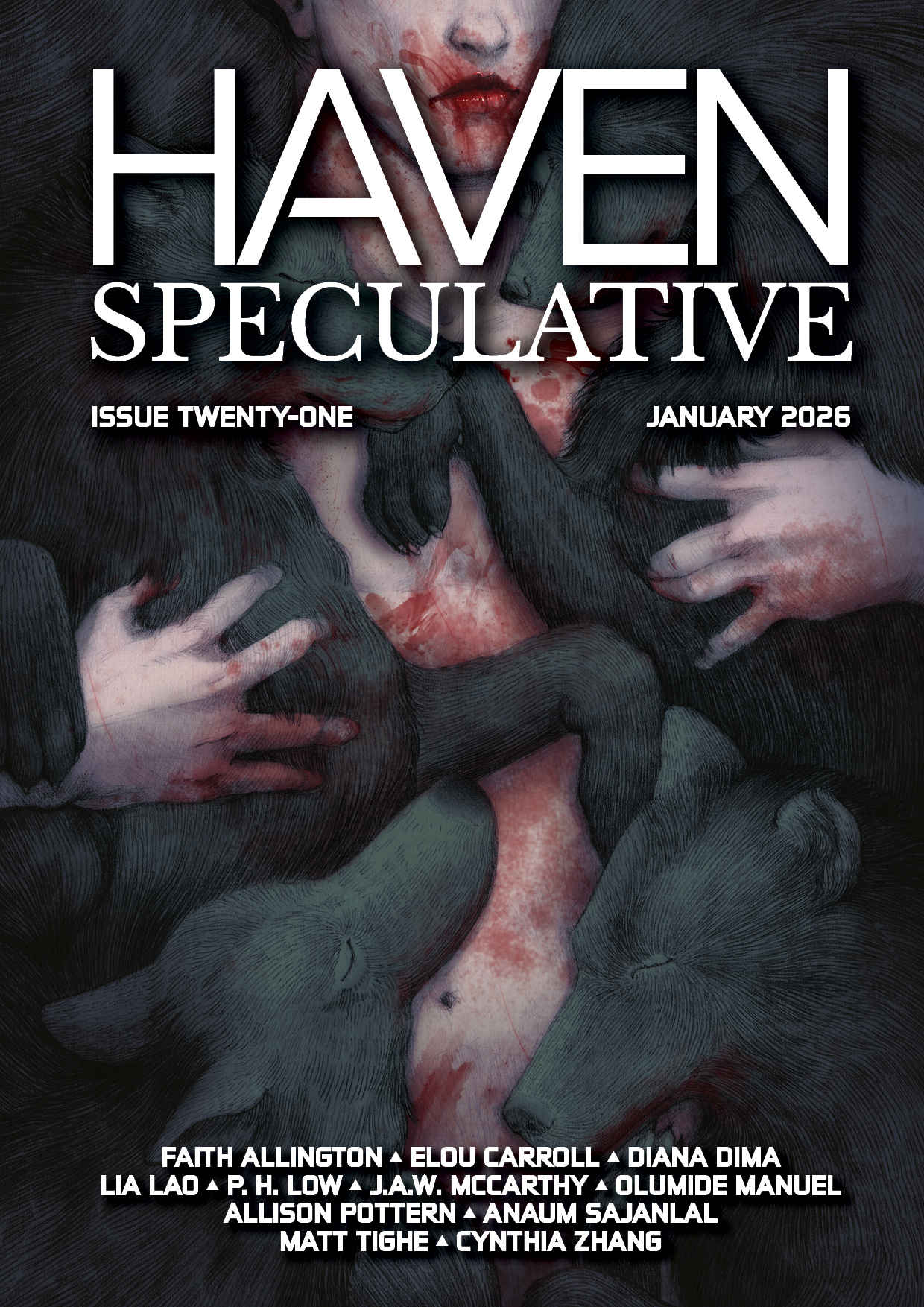
fiction
Bootcut
by Allison Pottern in Issue Twenty-One, January 2026
3479 words
Running your hand along the clothing rack, your finger catches on a Goodwill miracle: a pair of jeans that actually fits. They have no tag—no name brand—just a questionable stain below the left front pocket, no big deal. It’s like maybe these jeans have lived a more exciting life than you have. Maybe if you put them on, a bit of that excitement could rub off on you.
The flared, dark-washed jeans look like once upon a time they were very expensive. Now that they’re in your broke hands, they’re merely “vintage.” But in the claustrophobic changing room mirror, they make your ass look like a million bucks. And (can you believe it?) they only cost you $6.66 plus tax. The cashier even offers you a band-aid for your finger, which is welling with ruby droplets of blood.
You hadn’t noticed. You hope you didn’t get any stains on the denim.
(Don’t worry, with a little ice water, blood washes right out.)
You do get a lot of compliments, though most are from handsy customers and the gross owner of the restaurant where you work. When you get home at the end of your shift and strip off your garlic bread-scented clothes, you are almost surprised not to find greasy handprints all over your new jeans from all the assholes who touched you.
Only another six months of this, five if you’re careful. Then you’ll be able to buy Uncle Lew’s old camper, keep it gassed-up, get out of dodge. You’ve heard there’s a bottling plant in the next county—kool-aid or kombucha or something—that’s run by lesbians and actually provides employee health benefits. You’ve never had those before, they sound nice. But you’d be happy doing literally anything else besides serving cocktails to sleazeballs at a restaurant best known for its “Spaghetti Bolyonaise.” You only took a year of French in high school before you quit, but even you know the difference between meat sauce and mayo.
But in this town, it’s either waiting tables or the Amazon warehouse. The skittish new hostess, Sheila, confirmed your worst fears: they work you to death in that hellhole. Sheila’s cousin, the redhead, bled straight through her panties over there because her boss wouldn’t let her leave for five minutes to put in a fresh tampon. Her other cousin, the pregnant one, almost passed out. They wouldn’t let her grab her water bottle or sit down until she’d hit her picking quota.
Don’t trouble trouble. Five more months. (You think you can do this, don’t you?) You resolve not to wear the jeans to work. But the next morning, they’re lying neatly folded (the stain doesn’t even show!) and you decide to try them on again. Just to see.
Damn, you look good. Powerful. Even in the godawful, low-cut, lime green Arrivedercheese t-shirt uniform. Men, even customers, don’t have any right to get between you and looking this hot.
By lunch, though, you’re regretting it. The catcalls, the stares. Until finally one of your customers—some sales rep in his late fifties, not even a regular—tries to cop a feel. But instead of a knowing chuckle, he yelps and jerks his hand away. You stabbed me! he shrieks, suspiciously examining your backside. Something definitely happened—you felt it—a rage being honed to an edge. Not to mention the man’s hand is bleeding all over his Caesar salad, extra anchovies and croutons, as well as the tablecloth (ice water, you’ll need ice). You get a dressing down from Pete the Creep, proprietor, and you have to turn out your pockets (and hand over all your tips). Then, so they don’t get sued, Pete says with a smirk, It’s time for a pat down.
(He takes his goddamn time.)
You run out into the darkened parking lot with that tight, breathless rage still sharp in your chest. And there, illuminated by a streetlamp like it’s ready for its solo, is Pete’s big-ass truck, with its fancy rims and BO$$ vanity plate. You reflexively reach in your back pocket and feel it: a silver key that’s been filed to shiv sharpness. You don’t know where it came from—it hadn’t turned up in Pete’s exhaustive search and you certainly didn’t put it there (did you?)—but it feels right in your hand. It’s perfect for stabbing each of The Creep’s four, bloated tires.
When you take the jeans off that evening, there’s a worn spot on the back right pocket, shaped like the key. Like the key was a talisman you always carried. Always there, waiting for you.
You start wearing the jeans regularly. Like armor.
Of course, he knows it was you (how could he not? The way he’s always watching you). His anger stalks you around the restaurant, biding its time. You avoid him for as long as possible, but it’s not even a week before he corners you in the walk-in.
You try to scream. Shut your damn mouth, he says, grabbing you by the throat and pinning you to the frigid wall. What if I slash these tires? he says, clawing at your breasts with his free hand.
You can’t respond, he’s got his thick fingers around your windpipe. All you can do is hate him and struggle to breathe, while staring at the shrink-wrapped slabs of red, raw meat on the metal shelves beside you, the overwhelming smell of bleach from the weekend’s deep clean before a health inspection. Black stars crawl at the edges of your vision. Your only solace is maybe it’ll finally get him locked up, if he kills you so obviously, his fingerprints embedded in your neck, your corpse on the floor of his restaurant. Definitely a health violation. Maybe it’ll get the whole shitty place shut down.
Then your denim-clad knee comes up hard between Pete’s legs, like a piston, and he crumples to the floor, taking out a crate of cabbages. You wheeze and watch him whimpering among the vegetable scraps.
(You could kick him. You feel it, in your hips, in your legs. Kick him again and again. Until he stops whimpering altogether.)
But that isn’t you, is it? No, of course not.
You stagger out.
Over the next few weeks, one by one, the female servers take you aside to ask how you managed to get The Creep to leave you alone. You just shrug because anything else sounds too crazy. Because, in your terror, you did what you always do—shut down, waited for it to be over. Even if it meant your life.
You realize: you never talk about men. Not in any way that matters, not about what they do and do not have the right to. No talking, only whispers. About Pete the Creep, about the girls who come out of the kitchen crying, or about Sheila, who shows up to work vacant-eyed, jumpy. Whisper whisper, her fiancé.
Not all men are terrible, you know that. You’ve had halfway decent boyfriends, if you’re feeling generous. You like the restaurant’s most reliable bus boy. He’s kind and politely asks you about your tattoos and seems actually interested in what you have to say. Like a genuine human and not a steaming pile of garbage like Pete or Sheila’s Fiancé or Mr. Caesar Salad Extra Anchovies and Croutons.
But the jeans. They came alive. They took control. You didn’t do anything, the jeans did. They contracted and used your legs to hit him where it counted.
And they made you want to hit him more.
This morning, Sheila comes in, eyes red, hands shaking, already apologizing for existing. Through the restaurant doors you see the hulking bat-shape of a man. The fiancé. Sheila constantly checks over her shoulder, checking if the figure is still there.
He is. Every time.
You manage to get her back into the kitchen, away from the door and the shadow and the man, to pour her a cup of coffee. But you don’t say anything. What is there to say? You’re marrying a psycho? Sheila doesn’t need you to remind her.
Only four more months and you’re gone, you remind yourself. You finger the sharpened key and count your tips. You can stand four more months.
You start waking up in the jeans. Your sleep has gotten worse lately, so it’s sometimes hard to remember if you got undressed the night before. The jeans are never wrinkled or creased. But there is still that stain, always the stain, that has started to spread: running down the inside seam to the point where Pete, who’s been avoiding you, or maybe just biding his time, pulls you aside, his grip clenching the flesh of your upper arm, and hisses Get yourself cleaned up.
You try, shakily, in front of the dirty mirror in the employee bathroom. Red marks on your arm from where his fingers, like overstuffed sausages, dug into your bicep. All you can think about is crushing them under your heel, bursting them from their casings (how he’d scream, how easy it would be.) Instead, you’re re-applying concealer that does nothing but cake in the hollows beneath your eyes and make you think of poor, shattered Sheila.
Rubbing at the stained denim with hand soap and paper towels does nothing. Neither does a stain stick, nicked from Sheila’s purse. At home, you’ve tried vinegar soaks, harsh detergents, running it through the washing machine over and over. No change. These jeans—dark wash, bootcut, perfect fit—might have a stain. But they don’t seem to care.
When you’re done with your shift, you stumble upon them: Sheila, pinned against the brick wall of the restaurant by a man’s looming shadow. He isn’t touching her, but even from where you stand, you can hear his low, poison murmur. Why do you make me say such mean things? All I want to do is trust you, but then you go and wear that shirt, those shoes, that skirt. Thinking someone would want you. I’m the only one who wants you. You should be grateful. You’re mine.
You’re going to say something, yell at him, call for help. (Help for what? It’s not like he’s hitting her.) The words pile up in your throat, burning. But then the man turns, his glasses flashing, and he’s definitely The Fiancé because of those ice-cold baby blues Sheila’s always going on about.
(You could kick him in his Bolyonaise like you did to Pete. You’re wearing your, what the salesclerk called, “good ass-kicking boots.” They go great with the flared jeans.)
(You could do it. You just have to get past those eyes.)
The Fiancé’s gorgeous eyes glitter. He looks like he’s just come from shooting a cereal commercial, like the kind of man you’d ask to pet-sit your golden retriever, if you had one. Somehow, that’s worse. Bleached blonde hair and eyes that know how to make you feel simultaneously like you won the lottery and you’re nothing but a worm. Just an arch of a brow lets you know this man takes what he wants, and crushes what he doesn’t.
(Like you.)
In short, he’s fucking terrifying.
The Fiancé herds a shaking Sheila into a non-descript black car. This guy doesn’t need a souped-up vehicle to let you know where all his edges are. Through the windshield, his eyes dare you to act.
(As if you could.)
(You could though. You could do something, couldn’t you?)
The jeans feel too tight. You take a step toward the car, despite the hot bile rising in your throat, the quaking in your calves. You call out, something wordless, trying to get Sheila’s attention in the darkness of the backseat.
But you’re too slow. (As usual). You’re blinded by headlights, deafened by the roar of a car engine. The Fiancé screeches by you, splashing you with a wave of gutter muck. Then they’re gone. He has her.
(And what do you have?)
Legs. You run.
The next morning, you wake up in the jeans again, after definitely, 100% shoving those mud-soaked shame pants to the bottom of the clothes hamper. Your feet and hamstrings are killing you and there’s something in your pocket again, the left one this time: a silver matchbook for a bar over on Davidson, one that you’ve never even been to.
You keep the sharpened silver key on your keychain. Now, you slip the silver matchbook into your bag. The jeans no longer smell of sewer, but of cigarettes. So does your hair.
(No, not cigarettes.)
(Smoke.)
As you drive to work, you find yourself crossing Davidson Boulevard, even though it’s the long way around. You pass the bar where the matchbook must have come from, but only spot bright, yellow police tape before you’re through the intersection, and it’s in your rearview. Good riddance, you think even though you’ve had zero opinions about that bar until this very moment.
Sheila doesn’t come to work that day, but the next she shows up clear-eyed and calm. The police stop in to talk to her: did he have any enemies, did anyone at the bar hold a grudge against him, do these mean anything to you? A cop hands her an evidence bag with a melted pair of glasses inside, the lens cracked and blackened. You just pour the coffee, which (of course) the cops all expect for free (with a smile!).
Several of the cops know The Fiancé, like him, can’t understand who would do something like this to such a stand-up guy. Right. Even though you don’t know The Fiancé, per se, you know men just like him. Who take and take from a woman until she is so small and empty, he can crush her in his fist.
(So you took first.)
Wait, of course you didn’t. What are you thinking? You didn’t even know the man’s name or where he worked until the cops showed up. (Except the matchbook. Except Sheila’s sober face that avoids your gaze. Except the burn blisters that glint silver on the tips of your thumb and forefinger.)
But no one asks you anything. No one looks through your bag. Why would they? You’re a pair of legs and a bottomless basket of breadsticks. No one notices the stain, a tunic top hides many sins. No one bothers to check if the matchbook exists and if it’s missing any matches.
(It does. It is.)
Your sleep gets worse and weirder. You lie in bed, hour after hour, naked legs twitching, unable to get comfortable. You start having dreams. Walking the town at night, looking for something, for someone. (Who? You know.) Your legs growing too long for your body, for any body, almost prehensile. You wake up freezing or sweating, exhausted and always with those god. damn. jeans cupping your hips, like an offering.
You always wipe your feet at the door, but some mornings, there’s mud on your boots.
Sheila quits the restaurant. He finally woke up, the whispers say, but isn’t right in the head. You wonder if she’s gone to work in the coal mines of Amazon or if she’s left town. Or maybe, somehow, The Fiancé got to her anyway, even from his hospital bed.
The new new hostess, Bambi, says Sheila’s got family in Omaha. Or maybe the Ozarks. Definitely someplace exotic. Surely, she’s gone to be with family in this trying time.
Are those heritage denim? she asks, looking your legs up and down with wide, doe-eyes as she unflinchingly mops up the apocalyptic aftermath of a 4-year-old’s spaghetti dinner. No wonder you’re always rockin’ them. Good denim loves being worn. The fibers, apparently, conform to your body from your own body’s heat. Which doesn’t explain the sleeplessness, the dreams, the feeling that you’re fraying at the edges. But maybe it’s why this second-hand pair of pants feel like a second skin.
Cold water and a little soap, she advises for the stain, when you ask. Dab, don’t rub. No chemicals. Air dry. But she doesn’t see any reason to alter them. Vintage jeans like that, she says, they got memory. And memory doesn’t wash out easy.
Bambi has baby blonde curls and a sweet smile that blurs the longer you look at her. If you weren’t so tired, you’d warn her: sweetness like that is dangerous. It’s the kind of sweetness someone like The Creep would be very pleased to squeeze out of her.
You were asleep, you know it. You remember crawling into bed, optimistic and relaxed for once. You finally hit your savings goal and Uncle Lew was more than happy to sign over the camper’s registration. Plus, the bottling plant, with its beverages and benefits, definitely exists: it’s called Kom-Butch-Yeah! You have an interview lined up next week. You’ve even tried their tangerine flavor and it’s not bad. Bonus? You haven’t thought of Sheila in at least three days.
But you come awake standing, swaying in the middle of Arrivedercheese’s dining room. It’s long after closing. The tableau: the restaurant all dark brown shadow, except for where fluorescent light spills out from the kitchen. The chairs are turned up on the tables, except one. Bambi lies across a four-top, hair tangled in the salt and pepper shakers, skirt hiked up and legs in the air, with Pete’s hairy, naked ass jiggling between them.
What the fuck are you doing here? Pete asks you. His pumping falters, but he tries not to show it. Bambi stares vacantly at the stained drop-ceiling, not making a sound.
Get off her, you say. Your voice is different. Like you’ve swallowed something sharp. The jeans stretch and contract around your calves, warm, like they’re breathing. (Can you? You can.) You take a step towards Pete.
Hey, we’re two consenting adults, Pete says, isn’t that right, sugar? He strokes Bambi’s bare thigh. She doesn’t answer. He pinches. Hard.
Yes, she says, Yup.
What did he promise her? A raise? The chance to keep the tips she earned or the job she was hired for? Or extra cash for the job she didn’t know she was applying to? Maybe she’s smart, knows men like Pete, knows she has to get this nonsense out of the way before she can really get to work.
(But she shouldn’t have to.)
See? Pete says. Everyone’s happy. He pats the girl’s bloodless flank before turning his piggy eyes on you. Now get the hell out of my restaurant. Unless you want a turn. He looks you up and down, like a cat licking entrails from its claws.
You reach in the back pockets of your jeans for the key or the matchbook or anything that could be used to defend (or strike). But all you have is your own two hands.
And legs, twitching for a fight.
(They are already wrapping around him, hauling him to the ground. He squeals as he goes down. Knee to the sternum, a bootheel to the chin, to the flimsy cartilage of his nose. You straddle his throat, your knees gripping him in a headlock as he chokes on the blood streaming down his face. All it would take is one sharp twist.)
Bambi sits up, dazed. She grabs a handful of thin napkins from the silver dispenser and tries to clean herself up. Tries to find her panties. You know they’re probably stuffed in Pete’s pocket as a trophy. You heard the whispers, even when they were almost too quiet to hear. Even when you pretended not to.
(If you’d only had the guts to do this sooner.)
(So do something now.)
You’re so dead, Pete sputters from between your thighs.
A bubbling laugh rises in your throat. As if this poor excuse for a man, bloodied and splayed on the linoleum beneath you, would be allowed to cause any more harm.
Bambi’s eyes flick to you. Her curls are limp, her mascara smeared. There’s nothing sweet about her expression now. It occurs to you that the two of you are about the same size. The jeans would probably fit her too.
(And she would definitely help you hide a body.)
Oh, you could make one helluva mess. But you’ve got a getaway vehicle now and Bambi is here, watching you, waiting, her gaze all ice water and steel. She knows where the cleaning supplies are kept, the mop, the bleach, and how to make blood-spattered jeans look like new. She doesn’t look afraid to get her hands dirty.
You’ve been cleaning up after bad men all your life. What’s one more?
Blood froths from Pete’s ruined nose. I’m gonna kill you, you flucking bi-
(Shut your damn mouth.) You constrict your powerful legs around him, tighter, tighter until The Creep whimpers (shhhh).
(Good. Now.)
You lean over, and whisper: (Not if I kill you first).
© 2026 Allison Pottern

Allison Pottern
Allison Pottern is a writer and reader of all things speculative, with a background in publishing, event planning, publicity, and bookselling. Based in Massachusetts, she has taught craft and marketing workshops at Grub Street Inc., Maine Writers and Publishers Alliance, and the MetroWest Writers Guild. She is a 2023 Viable Paradise graduate and is currently working on a cli-fi novel, her pottery skills, and as a marketing coach for authors. Her writing can be found in The Rumpus, Trollbreath Magazine, The Personal Canons Cookbook, New Year, New You: A Speculative Anthology of Reinvention, and forthcoming in Strange Horizons. http://pottern.com