
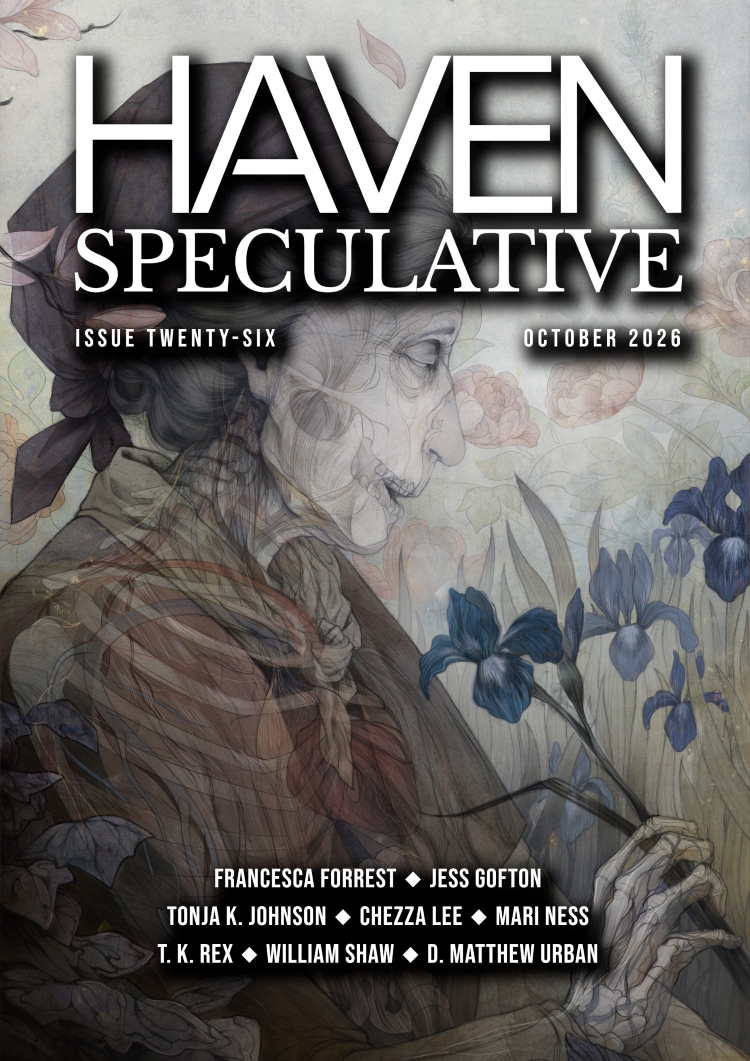
fiction
Butterflies of Ash
by Chezza Lee in Issue Twenty-Six, October 2026
3780 words
On the fifteenth day of the lunar month, when the moon is full, Tan lights three sticks of incense, dons her cloak, and walks with the dead.
The village is quiet this time of night, the gloom punctuated by the chirp of a cricket and a low voice from a nearby house, quickly hushed. The villagers remain safe in their homes, unable to share Tan’s duty. She is the only one who can see the spirits, after all. This is her burden to bear.
Her steps whisper through grass as she passes one house, then another. They are humble structures, crafted from timber with low, sloping thatched roofs, formed anew after the inferno that razed their village to the ground. Tan wonders once again about the resilience of people and their ability to keep trying once all is lost.
A man darts to his door, eyeing her warily before he hurries inside. The villagers rarely speak to her, especially on Full Moon Day, knowing she cannot answer even if she wants to. On the day the fire took their homes, the smoke also took her voice.
In Tan’s world, a young woman never has much of a voice to begin with; now, she has no choice but to live this half-life. She has stumbled past the edges of death and returned to a world that cannot understand her.
The villagers have left a misshapen clay pot for her, nestled in the grass beside the crossroads that lead out of their village.
May the ancestors find their way, she thinks. May they be remembered. The joss paper coins she uses to send wealth to the afterlife are cheap, but Tan does not have money to spare. She pulls a few from her cloak, uncaps her flame stick, and lights each piece before placing it gently in the clay pot. The night sky is dark, but it holds the faint outline of ash butterflies as they drift into the air.
Like the other villagers, she often wonders if the money will reach the dead.
The night shifts and the world grows hazy. This liminal space between life and death used to terrify Tan, but she is familiar with it now. Even the stars above are dull, the very sky cast in shadow.
For years, she has guided souls to the afterlife, unable to ignore their pain. They come upon her now at the crossroads, the faded outlines of former lives. There are fewer souls today, and Tan takes a deep breath. She never likes when there is a large procession, when the melancholy of too many souls weighs on her like clothing soaked in rainwater.
The first ghost walk was the worst.
It had been a particularly dry summer, and the thatched roofs didn’t stand a chance. An errant spark from an outdoor fire did its work, catching one house after another until they were all devoured by flames. She’d been sleeping in her small corner of the house and woke to the crackling heat too late. Her parents were weak from countless days of hard labour. She could not wake them, and she could not move them.
Neighbours pulled her from the house just in time, her throat searing with pain as she tried to scream through the smoke. She collapsed, unable to breathe, her body battered by ash and heat. A village elder later told her that she’d died, but only for a minute. Her lungs were feeble, and they’d struggled to work once more, drawing her back to the scrap of life she had left.
The last time she saw her parents was that night of the full moon, when Tan first glimpsed that hazy space between life and death undetectable by the normal human eye. The spirits of her mother and father tried to touch her, their fingertips passing through the skin of Tan’s arm like a hand trying to catch a reflection in the water. She walked with them, from the crossroads to the waiting maw of darkness at the field’s end, surrounded by the village dead.
The death of her parents left Tan alone in this world. There remains only a grandmother that she has never met. But Tan’s mother always refused to elaborate on her former life. Now, Tan has no one to speak for her and no way to speak for herself.
“There are less of them today.”
The croaking voice draws Tan out of her reverie. The spirit of the elderly woman is always there on Full Moon Day, and Tan has learned to take comfort in her presence. She is a friend, despite the barrier of death between them—a familiar, translucent face when the world turns dark. The old woman refuses to cross over, and Tan assumes she is afraid of the underworld.
When living is so difficult, Tan often wonders if she should take the leap and join the world of the dead. Having a friend, someone to walk beside her, helps keep that awful thought at bay.
“Have you been keeping well?” the old woman asks.
“Yes,” whispers Tan. It is a thin voice, rasping from her broken throat, more breath than sound. When she tries to speak during the day, not a word leaves her lips. But here in the in-between, the death of her voice finds its small resurrection in the presence of spirits.
“It is a struggle,” says Tan. “But I am trying.” Deep down, she hates her false positivity, but nothing is crueler than lamenting about life to those who have already lost it.
Tan burns the joss paper to send money to her deceased parents—it is a way to honour them in death, a tradition passed down from generation to generation. But she has met too many spirits in the in-between with no family left behind, and so she burns the paper for them as well. Only the dead know if the money will reach them.
There are five spirits this evening, not including the old woman, and they stumble along as Tan leads the procession. Most of their faces are rent with grief and resignation, but one man curls his lip as if offended by the musty scent of Tan’s village. He is a pale proximity of what he was in life, and Tan notes his expensive clothing and smooth hands. The rich always take to death with indignation, appalled at having to walk the same path as everyone else.
“This is unfair,” he snaps, grinding to a halt. “I was fine a day ago. There has been a mistake.”
Tan sighs, pausing the procession as she moves to his side. Sniffles and dry sobs cut through the silence of the night.
“Death comes for us all,” she whispers. “Your loved ones will ensure your happiness in the afterlife. There is no need to be afraid.”
“I am not afraid,” says the man, his eyes wide. His nostrils flare as he picks at the ridiculously large jade jinbu hanging from his belt.
“Those who lived a rich life will enjoy a rich afterlife,” she says. She does not tell the man that his afterlife hinges on a life of love, rather than one of riches. He will be fine if the people he left behind mourn him. She wonders if his family will continue to burn joss paper, or if they will do their perfunctory rituals and move on.
“My business was doing extremely well,” he mutters, but he begins walking again.
They leave the crossroads behind, heading to the darkest boundary of the open field, where light vanishes into never-ending night.
“You will be remembered in this world,” she whispers to the group. Her eyes linger on each face, letting them be seen once more. The spirits shuffle into the darkness, casting their final glances back at the world behind them.
The old woman does not enter.
“Make sure you eat, Tan’er,” she says, drifting back to the crossroads. The hazy world of the in-between wavers, and then Tan is alone in the field, the stars once again crisp against the backdrop of night.
In the early morning, she collects herbs to sell to the nearby city’s clinic. A few coins a day are all she can ask for, but it is enough to survive. She uses one to buy a few pieces of flatbread and a small bag of rice, remembering the old woman’s words. It is too easy for her to let herself go hungry on a normal day. Another coin replenishes her stock of joss paper, leaving her with just one to set aside with the rest of her paltry savings.
Her parents tried their best, but too often her childhood was filled with the ache of an empty belly. They were poor, but her parents loved each other, and they reminded her of that whenever she cried.
Love did not put food on the table, but Tan still honours their kinship through ritual long after they have gone.
“It comes for us all,” says a middle-aged woman’s spirit on the night of the next full moon. She wrings a handkerchief in her hands as they walk. “My daughter will mourn me. I cannot ask for more.”
Tan’s elderly friend is there once again, helping her guide the spirits down the path, though the old woman stiffens at these words. It is a quick straightening of her crooked spine, almost imperceptible, but Tan notices and cocks her head. She is not one to pry into the affairs of others, but she wonders about the old woman’s struggles—what kind of life she left behind, and why she refuses to enter the underworld.
The two of them lead the spirits through the boundary to the afterlife, but the old woman does not drift away as usual. Her lined face is troubled, and she presses her lips together so tightly that they turn white.
“Will you ever pass?” whispers Tan.
The old woman blinks, her gaze unfathomable. “When I am ready,” she says. “Though I have no family to mourn me.”
“You have me.”
The old woman smiles, a melancholy sight. “Have you made any new friends?” she asks.
“It is difficult to make friends when I cannot speak.”
The woman raises her hand as if to touch the side of Tan’s head, then hesitates before withdrawing. “Drink as much wine as you can in this life,” she says. “Not a single drop of it can be brought to the afterlife.”
“Help!” a voice calls. “Someone, please!”
Dawn crests the fields, and with it the scent of morning dew mixed with animal excrement. Tan is not used to hearing another person’s voice this early in the day, especially a man’s, and she pauses, stuffing the red peony roots she’d gathered into the small satchel tied at her waist.
In a valley nearby is a young man dressed in white robes plastered with splotches of mud. His clothes are tangled in the unyielding branches of a thicket of bushes. On his back is a wooden box weighing him down. Seeing no one else around, Tan approaches. He must be a fool to have gotten that close to the bushes in such flowing fabric.
“My apologies,” he says, “for shouting so early in the morning. I would appreciate the help.”
She pulls out the small knife she uses to cut the stems of herbs. With patience, she hacks away at the branches, tearing the fabric of his clothes when there is no other option. The man says nothing as she rips and tugs. When she is finished and he’s finally free, he puts his hands together and delivers a small bow.
“Forgive my foolishness,” he says with a smile. “There was a honeysuckle flower in the middle of the thicket I thought I could reach.” The man is younger than she expects, with an angular face and bright eyes that look at her with curiosity. He does not seem to mind that his robes are in tatters.
She nods and turns away, intending to return to her herb gathering, but the man calls after her.
“Wait. Are you from the village near here? What is your name?”
She does what she always does when newcomers try to speak to her, pointing to her throat and shaking her head.
“Ah,” he says, his eyes lingering on the peony flowers poking out of her waist satchel. “I am here to open a clinic in the village. My name is Shu Wei.”
The next full moon sees an influx of spirits, the victims of a bout of dysentery ravaging the poorer districts of the nearby city. Among them are children, and Tan’s heart aches at the sight of them.
The city does not have enough medical practitioners. Shu Wei has done all he can to protect their village, but the slums of the city are a different beast altogether. Still, he asks her to help, teaching her the ways of a healer. He makes use of every herb she gathers and invites her to drink tea when each clinic day is over. Alongside his work, Shu Wei always finds himself tangled in one patch of roots or another, but he sees her, and he speaks to her, never minding that she can’t reply.
“An awful thing,” says Tan’s elderly friend, letting her ghostly hand linger on the shoulder of a young girl’s spirit crying for her mother. “For a parent to see their child go before them.” Her hand trembles and she pulls it back, hiding it within her sleeve.
The walk is a quiet one, except for the cries of the dead and Tan’s reassuring whispers.
“My child also left this world before me,” says the old woman, after the last spirit ventures past the boundary. Tan lifts her head, eager to hear more. Her friend so rarely speaks about her life. “Though I do not think she would mourn me, were she still alive.”
“I am sure she would.”
The old woman shakes her head, the ghost of a tear brushing her cheek. “I made mistakes, Tan’er. I was so determined to control her marriage, to make sure she was with someone wealthy enough to protect her. I grasped too tightly, and she left me because of it. Now she is gone, and there is nobody who still remembers me as I was in life.”
She hesitates, her eyes lingering on Tan’s face.
“I hope you will remember me. I hope you will think fondly of me even after I’m gone.”
“Of course I will.”
“I only wanted what was best for her,” says the old woman, her words tinged with desperation. “And I want what is best for you. I hope you find someone who understands you.”
Tan comes to love the time she spends in Shu Wei’s clinic. The building is barely a shack, with a small room at the rear for sleeping. Patients are rarely asked to pay before they leave. If they insist, Shu Wei claims he is content with a small basket of vegetables or a serving of scallion pancakes.
The fine robes he wore the day they met gave Tan the impression of wealth, but Shu Wei likes to talk as he grinds herbs, and it does not take long before he tells her his story.
“I am from the city,” he says as he places jujubes on a scale. “My father was a scholar, though he never performed well enough on the examinations to become an official. We were comfortable, rather than wealthy.”
Tan wonders why anyone would leave comfort for this place, where dry coughs echo through the walls.
“I can guess what you are thinking,” says Shu Wei. He looks up from his scale to give her a small smile, and she hurriedly smooths her frown. “I have given up a life that many would strive for.”
His attention turns back to his ingredients and he mumbles to himself. “Licorice. Blighted wheat. Jujubes.” He gathers the ingredients and adds them to a bowl of tepid water. “Madam Lu’s pregnancy has been difficult, and I hate to see her crying all the time.”
Tan cocks her head. Most people shrug off the tears of a pregnant woman.
“Let them soak for a while,” he says, his attention turning back to Tan. “I left of my own will, in case you were wondering. An educated person can do much in the court or the city, that is true . . . but I wanted to see if there was more to my skills than using them for reputation or favour. I have travelled alone for a while, but I think there is enough to keep me in this village.”
She cannot help but turn her flushed face away. They both have chosen a painful path. There are no rewards for their choices—none for the girl who ferries the dead and none for the healer who cures patients that cannot afford to pay.
Shu Wei gestures to the ingredients soaking on the table. “It is a full moon tonight, so once the ingredients have soaked, I will deliver the tea to Madam Lu. I know you have your own duties to manage.” He hesitates before raising a hand, then settles it gently on the side of her head. “I will give you a heavy cloak to wear, since it may rain tonight. Stay warm, Tan.”
There is so much warmth filling her body in this moment that she doubts she will ever feel cold again.
“I am married,” says Tan to the old woman on the first full moon after her wedding.
“Is he kind to you?” demands the woman. “Does he have a steady income?”
The old woman often asks about Tan’s life, but these questions feel different. They are fierce and protective. Tan smiles and lowers her head, a warmth blooming in her chest.
“It is not much, but we will get by.”
The old woman’s mouth presses together once more, but then she sighs, her shoulders deflating.
“You are determined,” she says. “I can see it in your face. You have your mother’s stubborn eyes.”
Tan’s mouth opens, but she does not say a word. For years, this woman has walked by her side in the in-between, doggedly moving spirits from one life to the next. Never has she said such a thing.
“Tan’er.” The old woman’s eyes linger on Tan’s hands, the involuntary movement of her wrinkled fingers reaching out to hold what she cannot. “I only wanted you to know me. I was afraid if I told you, you would scorn me as your mother did. I know what it is like to be alone in this world. Cherish the ones who matter, even after they are gone.”
There is a sweet ache in Tan’s chest, and she dwells in the pain of it. She knows her mother ran away as a young woman, after Tan’s grandmother forbade her from marrying the man she loved. The idea of a grandmother has always been an abstraction, a fleeting thought that Tan has never lingered on for long. But now she understands—all this time, she has never been alone. There has always been someone watching over her.
Instead of drifting back to the crossroads, the old woman takes a firm step in the direction of the boundary.
“Remember me, if you can. You are the only one left.”
“I will drink as much wine as I can, popo,” she chokes out, addressing her grandmother for the first and final time. The old woman’s face brightens, and there is joy in her eyes.
Tan’s throat aches, and not because of her ailment. It is too soon to say goodbye. She has drifted alone through life, assuming nobody would miss her when she herself was dead. To know that her grandmother has been beside her all along, protecting and caring for her despite the barrier of death between them, is sweeter than honey. Tears slide down her cheeks as she struggles to speak, to beg her grandmother to stay.
But more than anything, she knows her grandmother does not belong here. The old woman has existed as a shadow, a spirit, for too long, all to keep Tan company when she needed it most. Her grandmother deserves to rest.
“I am glad I got the chance to know you, even though we could never meet in life,” whispers her grandmother, her voice thick with everything unsaid.
This fierce, stubborn woman, who ignored the call of death for the sake of her granddaughter, approaches the boundary with her head held high. “Live well, Tan’er, and remember us.”
A sob bursts from Tan’s throat as her grandmother is swallowed by the shadows.
When Tan is alone once more, she wraps her trembling arms around her body. She wishes she’d known sooner, but she is grateful for the time they had. As she looks up at the sky, she hopes her grandmother and mother are able to meet in the afterlife. She hopes they have the chance to repair what was broken.
Her fingers clench tighter, and she looks down at the fabric filling her hands. Shu Wei’s cloak. The weight of it calms her. Soon, breathing comes more easily until finally her trembling dissipates.
For so long, she has felt trapped by circumstance, forced to ferry the dead on each full moon, but now she understands. The procession of ghosts that she has led, month to month, has granted her what life could not.
She had a grandmother who cared enough to remain by her side, and parents who worked hard to give her what she needed. She has a husband who accepts her as she is and who listens to her with his heart. She has never thought seriously about her future, but now it opens up before her like a flower in the sun.
Tan returns to the crossroads, burning piece after piece of joss paper until her pockets are empty. Every scrap goes into the fire, and butterflies of ash fill the night sky. For the first time, her processions with the dead do not feel like a burden. They have become her purpose, and she will continue leading them until her own time to cross the boundary has come.
With the joss paper burned, she drops to her knees and presses her hands and forehead to the ground. She bows to those who have passed. To the parents who kissed her tears away. To the grandmother who walked by her side. To the dead who take comfort in her presence.
With Tan guarding the crossroads, they shall not be forgotten.
© 2026 Chezza Lee
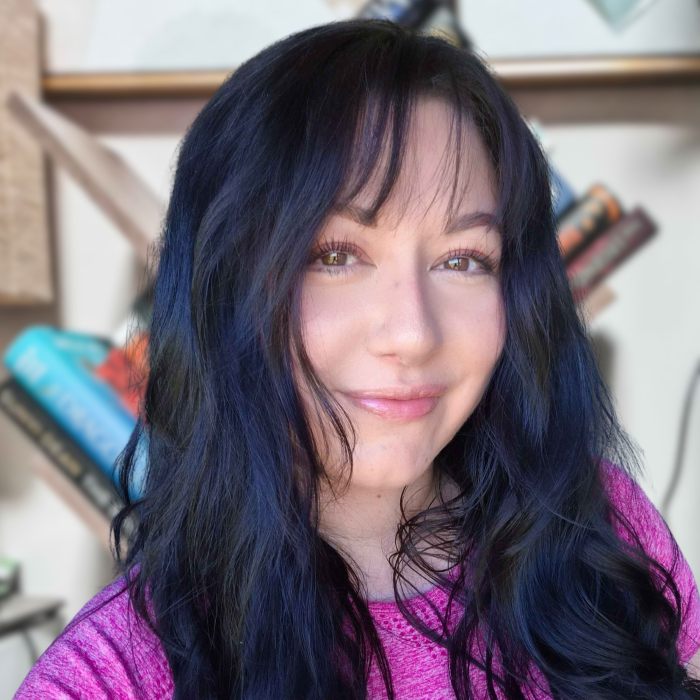
Chezza Lee
Chezza Lee (she/her) is a biracial Chinese-English fantasy writer living in Canada. She holds an MA in Renaissance Literature, and her work can be found in Beneath Ceaseless Skies and Heartlines Spec, among others. When she isn’t writing, she's either gaming, watching the latest historical cdrama, or reading submissions for Small Wonders. Find her at chezzalee.com.