fiction
In This Dimension, Do You Still Believe in God?
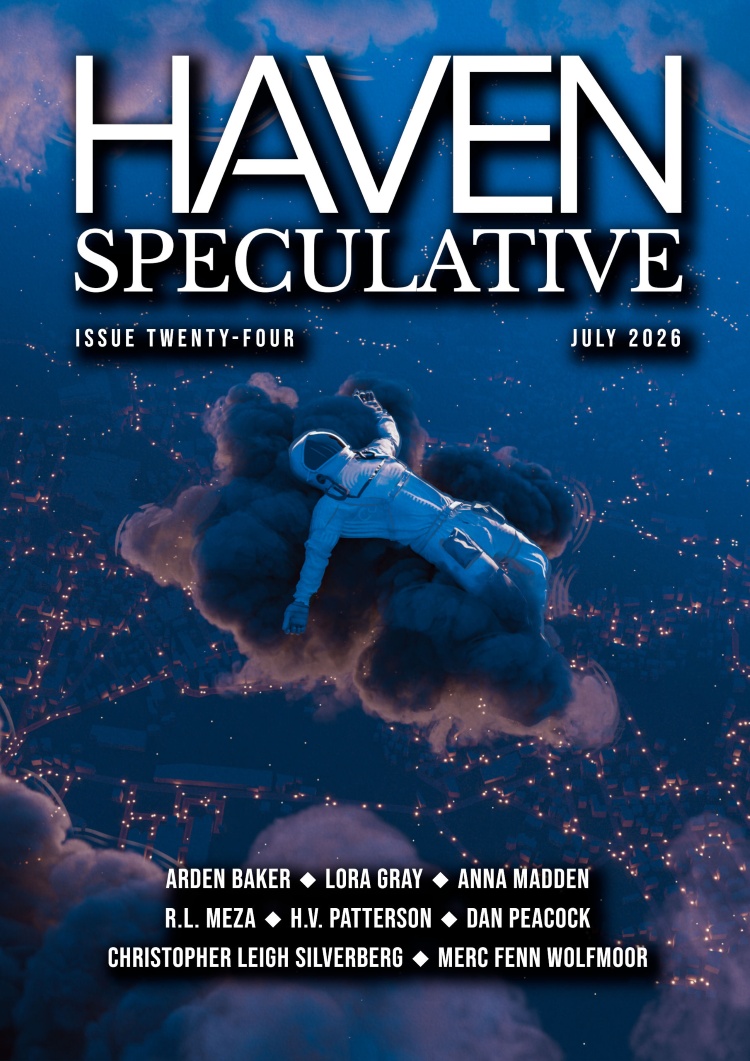
by Lora Gray in Issue Twenty-Four, July 2026
3164 words
Hope is seeing that tiny muscle in Abdi’s jaw move when I lean against his shoulder and breathe him in. Patchouli and oil paints. Garlic and rosemary. Home. I lay a hand he cannot feel on his arm and whisper memories into his ear like a prayer.
How long has it been since we held each other?
According to my instruments, I jumped dimensions six weeks ago, but the receiving end of the Interdimensional Bridge is glitchy in ways Jones, Croft and I never accounted for. Every time I activate the Bridge, it should bring me back to 00:00°, back home.
I rest my head against the sofa and check my position.
00.56°
Beside me, Abdi sinks deeper into an olive-green duvet I don’t recognize. It’s possible Abdi bought it on a whim after I left our plane of existence. It’s also possible my husband always had that duvet and I’m just now noticing it.
It wouldn’t be the first time I neglected to appreciate something.
I wrap my arms around Abdi. I try to hold him.
I thought you hated olive green.
He doesn’t respond.
The day I left our dimension, Abdi put on his powder blue suit, the one he’d worn as a security blanket to gallery openings and galas, graduations and funerals since he was a teenager.
I smoothed my hands over the worn lapel before straightening his tie and running the backs of my fingers over his five o’clock shadow.
“You’re not going to shave for the big send-off?” I tried to force a smile through my jitters.
Abdi turned to the bathroom mirror and pretended to be heavily invested in his cowlick, his long fingers twisting around an unruly, salt and pepper curl. “I thought you liked me scruffy,” he said.
“You do look good with a beard.”
“I’m not growing a beard, Caleb.” The curl he was trying to tame bounced defiantly out of place. “Just stubble. I want you to remember me like this. I’ll shave after the return party. A few days of itchy whiskers won’t kill me.”
“Abdi.” I spoke carefully. “Nobody really knows how long—”
“Do you think I should part my hair to the left?”
“Abdi.”
“Or I could slick it back. I’d look more academic that way, don’t you think?”
“Abdi, please.”
“What?” Abdi’s eyes, dark and fierce, locked on my reflection, daring me to remind him of the truth: nobody was certain what would happen when a person used the Bridge. My colleagues and I had run virtual simulations, of course, but there were so many variables we couldn’t account for. Only a field study would give us the answers we needed.
Between the university’s dwindling funds, our meager facilities, and the limited scope of the portable Bridge’s particle displacement field, we could only send one of us through. I might be gone for hours. I might be gone for days.
I might not come back at all.
Which was why I’d been chosen. Not because I was braver or more qualified, but because I had no children. No dependents. No living parents. No siblings.
Just Abdi.
I carded my fingers through my husband’s hair. His cowlick spiraled wildly to one side. “What difference does it make what your hair looks like? You look perfect, like always.”
Abdi didn’t reply. He held my gaze for a long beat and then, expression inscrutable, he went to find his shoes.
Every time I try to go home, the Bridge deposits me back into this dimension, back into this living room.
And every time I’m reminded of how beautiful Abdi is. There is an unassuming elegance to the way he drapes his jacket onto the hall tree, a delicate artistry when he toes off his Birkenstocks, one palm pressed to the wall, his mussed hair obscuring his eyes.
There are dark circles beneath them now.
Oh, darling, you look so thin.
Abdi hasn’t worn his powder blue suit since I left. In fact, he’s worn nothing but black for days. His beard has grown in, too, full and thick. Has it really only been six weeks?
I need you to know I’m not dead.
Tonight, like so many nights, he sits alone in the living room of our small apartment, the light from the antique television flickering over his face. He’s watching another late 20th century reality show, some stranger’s personal drama flooding the living room with tinny laughter and angst, an imitation of life that feels hollower for how removed I am from it all.
In Abdi’s hands is a photograph. Like the green duvet, I don’t remember it. It’s a grainy image, as if taken with real film, nestled in a gold frame. In it, we stand shoulder to shoulder on a pale beach. We smile wide at the camera, bare arms snug around each other’s bare waists.
Is it Bermuda? I lean closer. I’d been so preoccupied with the Bridge Project that our entire honeymoon was a distracted blur. I don’t remember that beach or the soft press of his skin, or the warmth of that sun against my back, or the way that broad-brimmed hat freckled Abdi’s cheeks and nose.
You deserved better.
The TV drones. Those two-dimensional people are like me, lost between realities, aching for connection.
I check my instruments.
00.42°
Abdi strokes his fingertip down the center of the photograph.
There are tears in his eyes when he hurls it against the wall, the glass shattering into innumerable reflective pieces.
Most of my time with the Project had been spent in the lab, that converted gymnasium squatting beside our apartment building.
It was a corner of campus that had been abandoned for newer smart apartments years ago. There were no sim walls or auto dispensers here, just a scant cluster of three-story, concrete buildings with questionable roofs and tile that hadn’t been replaced since the 2030s.
But living there meant I could scramble to the lab if inspiration struck. I could stay late if Croft or Jones had an engineering conundrum.
At first, Abdi seemed content. He’d quickly converted one of the neighboring apartments into a painting studio. “Natural light, see? It faces south!” The university was going to demolish the entire complex in a few years. Nobody cared about oil paint staining those floors.
For a while, I thought we were happy, but gradually, the sudden epiphanies that sent me sprinting to the lab in my robe and slippers, and the cold dinners, and Croft and Jones arguing equations at 2 a.m. in the courtyard, and the constant looming specter of greatness/failure only steps from our front door became everything.
I barely noticed when Abdi grew quieter and more distant. I barely noticed as his smiles faded and then disappeared all together.
The morning I left our dimension, Abdi walked slowly across the repurposed gym-turned-laboratory, around the concrete slab and the modest platform where I would be launching, with its carefully placed sensors and safety nets. He cocked his head.
“Nice to finally meet you.” He pantomimed shaking hands with thin air and there was a wryness to his voice, as if he expected the thing that had seduced his husband away from him to be more glamourous.
We didn’t kiss before I suited up, the portable Bridge strapped securely around my body, and by the time I realized we hadn’t properly said goodbye, I had a respirator clamped over my nose and mouth, electrodes on my temples and forehead and everybody was leaving me there on the platform, moving to the control booth on the other side of the gym.
I lost Abdi in the shuffle, but I could see Croft pacing, forefinger shoving his glasses back up as they slid down his nose, Jones tense beside him. The department donors, the few that bothered showing up, mingled behind them, drinking wine and eating cubes of cheese from paper plates. A lone university reporter scowled, bored as she jotted down notes on her tablet. Nobody would be interested in this experiment outside of a few obscure scientific journals and our department, unless there was an accident.
Real blood, at least, still sold.
When I finally spotted Abdi in the control booth, he was standing to one side, his eyes downcast as the dean of the physics department gave his speech, his voice distant through my earpiece.
“…the next great achievement in human exploration…”
Abdi wrapped his arms around himself.
“…the opportunity to discover if variations of our own dimension really do exist, or if that is simply the stuff of science fiction…”
Abdi bowed his head.
Look at me.
“…regardless, we can use this technology to open doors for new methods of travel. Imagine being able to touch somebody from thousands of miles away in an instant…”
Please look at me.
Jones checked my vitals like we’d done so many times before in our virtual simulations.
“Position is go,” she said.
My eyes were on my husband as I took a deep breath. “Position is go.”
“Launch is go.”
I swallowed hard. “Launch is go.”
I flipped the switch on my wrist. The Bridge hummed to life. We’d done this before with rubber balls. Fruit. A pile of sandbags approximately my height and weight. I’d seen the shimmer, the mirage-like waves of displaced particles, the sudden disappearance and reappearance of a dozen dispensable somethings.
But now, I was that something and there was a crackle, sharp pops like firecrackers against my skin. The particle displacers strapped to my body opened like eight dark mouths yawning. There was a gut-deep pull, as if I’d swallowed a magnet and another was trying to yank it back out again through my bellybutton. The fillings in my teeth strained against the enamel. My head snapped back. My body bowed. There was a sudden jolt, a dislocation, and then a puckering inward. Inward. Inward. I righted my head against the strain and tried to focus on the control booth.
Jones’ hands were flying over the control board. Croft had stopped pacing and was gaping at me. Me. And Me. Two of me. Three of me. A dozen of me, pulled apart and somehow still connected, strung together like paper dolls. In my periphery, I saw a hundred cheeks and arms, fingers, and taffy-long necks.
I opened my many mouths and screamed.
He does not hear me.
In this dimension, do you still believe in God?
Of course he doesn’t hear me.
It doesn’t stop me from trying.
My scientific curiosity ran its course weeks ago. Every time I activated the Bridge, it was always the same time of year, the same world, the same apartment, the Bridge glitching and hurdling me five hundred feet away from the lab. Every attempt to leave the apartment on foot shot me back there to the living room again, a maddening loop I was forced to repeat ad nauseum. I recorded all I could, I was trapped there.
Invisible.
Miserable.
Unable to touch or talk to anyone, including Abdi.
I began to pretend my husband’s silence was anger. Abdi was ignoring me on purpose. He wasn’t walking into the kitchen when I spoke because he couldn’t hear me. It was punishment for all those late nights, the cold dinners, the ambivalence, the day I’d snapped at him when he came to the lab unannounced. He’d brought take-out from our favorite Turkish restaurant and stood there in the courtyard, that liminal space between work and home, looking wounded as I barked about not having time for this! I was doing real work. Important work. Couldn’t he just reheat that food later?
God. It was our anniversary.
Now, when I beg him for forgiveness and he doesn’t answer, I know I deserve the silence.
He has every right to hate me.
The trouble is, I can tell Abdi isn’t angry.
Abdi is grieving.
He isn’t eating. He isn’t going out. There is no charcoal on the outer edge of his pinky finger from sketching. He isn’t absently massaging his neck from hours spent hunched over canvases. He simply slumps on the sofa, watching ancient reality television. Occasionally, he raises his hands, framing a would-be composition between his fingers. Sometimes, he lets his hands hover mid-air, like he is bestowing some secret, sacred blessing on those television people, before letting them fall back into his lap.
Abdi once told me, when we were curled together in bed, his head pillowed against my chest, that painting was “like being God. Just for a moment, you’re divine, you know? You’ve created something out of nothing. It’s beautiful.”
Maybe all Abdi needs to do is pluck a rib from one of those television strangers and breathe a whole new husband into existence.
I’m not dead.
Death was always a possibility. I knew that going in.
I am not dead.
00.32. I’m so close.
Look at me.
Abdi turns his head, profile illuminated by the flickering blue light of the television.
I grip the back of the sofa and lean in, trembling, inches from his ear.
I’m right here!
I storm the length of the living room, the desperation I’ve been battling for weeks finally bubbling into something uncontrollable. I stand by the front door as if I don’t know that walking outside won’t pop me right back where I began, as if I could, in my rage, actually leave this hell.
I’m right fucking here!
That’s when my beautiful husband turns to look at me.
No.
He looks past me.
Because the front door is opening.
And I am walking through it.
Abdi was born Catholic to a single mother. He told me this on our third date in a dimly lit cocktail bar near downtown, the lights warm and pink.
“Not that I ever really subscribed.” Abdi had swirled his scotch in a lazy circle. Our booth was tucked away in a quiet corner, an illusion of privacy that felt increasingly intimate as the night wore on. I wanted to stroke my finger along his, drawing absent doodles on the glass tabletop where his drink had been sweating. I didn’t yet dare. “I never liked going to mass. It was all so formal, you know? Fussy. But the stained-glass windows were nice. Do you believe in God?”
I’d laughed, just buzzed enough that I wasn’t self-conscious about it. “Do I believe in God?”
“You know. The divine. A higher power. The afterlife. Where do you think we go when we die?”
“The ground, I suppose.”
“Like ashes to ashes, dust to dust? Or is that the scientist in you talking?” Abdi had said it fondly, as if I was something unexpected and delightful that he’d discovered in a jacket pocket.
When Abdi’s mother died, his father took him in. He had never approved of Abdi being gay and Abdi hadn’t spoken to him since he’d left home at eighteen. He had refused the invitation to our wedding.
But when his father was dying, Abdi brought me to his hospital room. Taking my hand, he stepped closer to the fragile shadow of the man he’d been named after, the man who looked so much like him, even dying, and Abdi had whispered, “Hello, baba.” His fingers tightened around mine. “This is Caleb. This is my husband.”
Abdi’s father said nothing.
He simply looked away.
When he died two days later, I wasn’t there. I was at the lab. I came home to find Abdi staring vacantly at the television, an ancient reality show blaring, a crumpled handkerchief clutched in one hand.
When I wrapped my arms around him, he didn’t cry.
The Caleb that isn’t me walks through the front door of the apartment. He is rain drenched, his hair longer than mine and dusting the collar of a rumpled, corduroy jacket. There are circles beneath his eyes that match the circles beneath Abdi’s.
I tell myself I was foolish to think this Abdi was mine. I’m an idiot for believing this beautiful man was mourning me. I try to tell myself my laugh isn’t bitter when I watch this other Caleb surge forward to kiss this Abdi, whispering, “I’m sorry, I’m sorry, I’m sorry.”
Which version of me, pulled apart like taffy in the lab, is gripping this Abdi’s crown of salt and pepper curls? What did he do to make his beautiful husband grieve so profoundly?
The pain of watching them/him/me tumble to the sofa lances through my belly and heart and brain so keenly that I’m running out the door before I can think better of it. I bolt into the downpour. I am ripped apart. I am returned.
Again.
I cannot watch this version of me rekindle the light in any Abdi’s eyes. I cannot watch this version of me mend something I have ruined again and again, and I am screaming as I watch this me that isn’t me and this Abdi that isn’t my Abdi intertwine.
I am weeping, I am howling, when I fall onto the olive green duvet with them. I sink my hands into this other Caleb’s hands, a quavering uncertainty that shucks itself away from cartilage and organs. My hand, his hand, our hand, closes over my wrist and we flip the switch there. We shudder. The Bridge shudders with us. Eight mouths open wide. A world of Calebs quiver. I am flesh inside flesh. My nails rend skin. Muscle. Bone. Forefingers pierce a stranger-not-stranger’s familiar hand, puncture wounds like stigmata. We bleed, and then, release.
A universe opens above me.
Darkness swallows us. All of us. Innumerable us.
00.00
We are legion.
My Abdi is where I left him, in that inglorious lab, and I know he can hear my many voices through the control room speaker as I cry. My Abdi with his powder blue suit and stubble, his hands pressed to the glass as if in supplication as I return, my hundred bodies, eyes and legs and arms separating and reaching for him and only him.
I need to hold you.
There is a groan, my many bones breaking, and Croft and Jones and all those donors and the dean and that reporter, her eyes hungry for blood, watch the horrible yawning, those eight mouths swallowing arms and legs whole and snapping pieces of flesh away, tossing them to the ground like paper dolls. I am breaking. I am broken. My vision begins to separate, but I find him.
My Abdi is looking back at me.
He is beautiful.
I only want to hold him with these hundred arms. I only want to ask if he still believes in God and kiss him with every mouth I have and beg for forgiveness forever and
forever and forever and forever and over and over I will hold you I will hold you I will hold you I will hold you I will hold you I will hold you I will
© 2026 Lora Gray
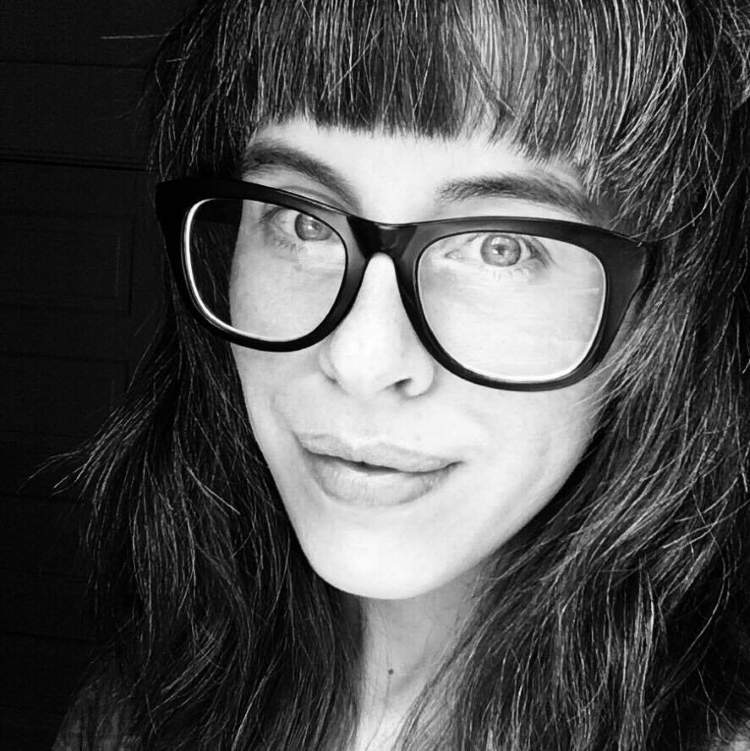
Lora Gray
Lora Gray (they/them) is a non-binary speculative fiction writer and poet from Northeast Ohio, and has been published in Uncanny Magazine, F&SF, Strange Horizons, and Asimov's, among other places. Lora is also a graduate of Clarion West, a recipient of the Ohio Arts Council's Individual Excellence Award in Fiction Writing, and has been nominated for The Pushcart Prize and the Rhysling Award. You can find Lora online at lora-gray.com.