
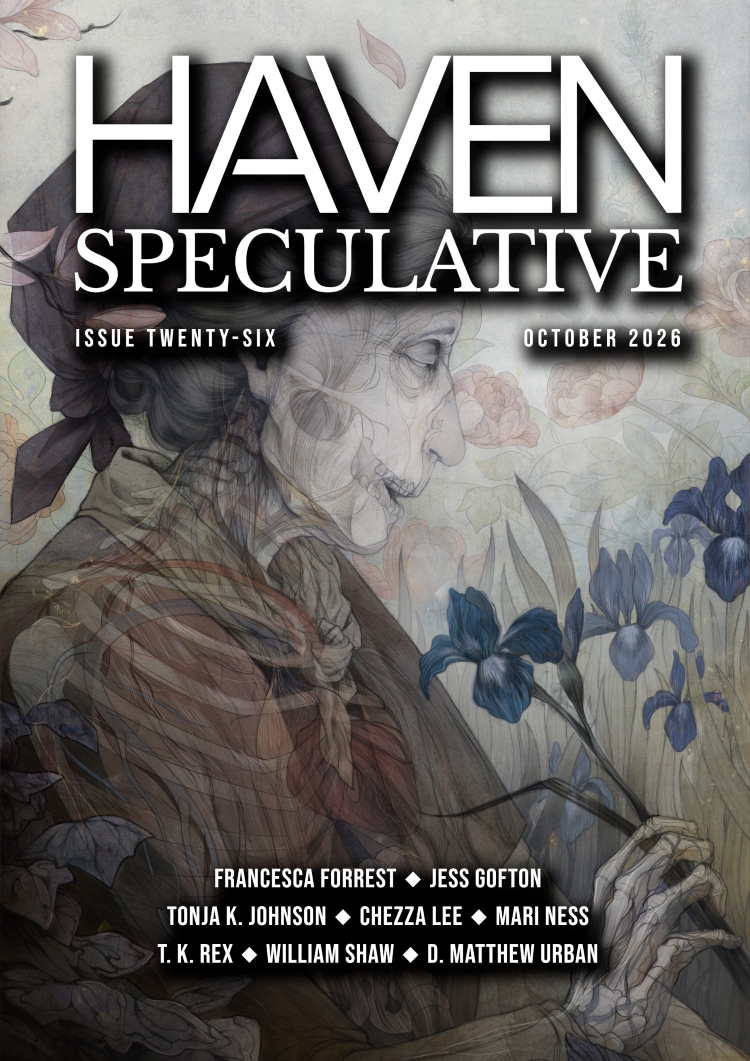
fiction
Last Shot of the Noritsu Minilab
by T. K. Rex in Issue Twenty-Six, October 2026
1533 words
It was the days when every camera store knew its time was coming, when even diehard film enthusiasts like me would inevitably realize digital took up a lot less space in a dingy San Francisco studio apartment. I was a freshman art student working at the Ritz Camera on Polk Street, where my manager Cesar and I both knew, but never said out loud, that we would be the first to go.
The shop was gaunt even when I started, fluorescent lights too bright and the red-carpeted floor too wide for how little stock we carried. Entire days would go by with no customers, or only one, coming by to pick up film they dropped off months ago. The Noritsu minilab machine, where I processed photos a roll at a time, was already ancient, the plastic outer shell yellowed and the inside chemicals unbalanced, so every photo came out slightly green. No one came to calibrate it anymore, and neither Cesar nor I were trained for that.
The Noritsu minilab is hard to describe unless you’ve seen one in person. Imagine a printer the size of a rhinoceros. It made machine sounds, hums and whirrs, uurgs and shnnks, and it smelled like carcinogens. The shape was boxy and angular all at once, hiding unknown gears and liquid chemicals within its black interior. At the far end by the wall, there was a small working surface with a control pad and a too-low chair, where I would peer into a tiny viewer at each photo being processed, adjusting the exposure and color balance until it plausibly resembled reality. What the chemicals inside would do with those instructions was anyone’s guess, but on my end, every photo looked as it should. Composition, focus, and artistic merit were all up to the customer who took the photograph, and always lacking. Professionals went elsewhere.
The day that was the beginning of the end, I decided to take on the monumental seventeen-roll order someone had left the week before. The first roll was depressingly dull: yellow rocks in glaring sun, the tip of a faded sneaker, half a backlit shrub, a sliver of a boulder on the edge of cloudless sky. The sharp corner of a car door, with a blurred desert landscape behind. There were 32 exposures in each roll, and I began to dread that they would all be this eerily banal.
By the second roll, I became fascinated by the persistence of the customer in capturing meaningless detail, not a single face or animal, not a single landscape with half decent lighting, not even a sign or marker indicating where they were. Just pointless rocks and sky forever. Was it the Mojave? The Sonora? It could have been Area 51, bong-smoking aliens just out of frame, and I would never know.
The third roll found me in a frustrated trance, and by the fourth or fifth roll I was lost in them. I imagined I was there, stumbling through this nameless desert, never looking up except for dead into the vacant blue above, aimlessly pointing a camera I’d forgotten I still held.
By the ninth roll, my mind began to fill the emptiness with meaning. Rocks at certain angles could resemble grotesque masonry, or haunting faces, like the one on Mars. In the shadows, there were miniscule, almost-human silhouettes. I blinked. I rubbed my eyes. I looked up toward the checkout counter and the door to Polk Street, and Cesar was already back from lunch. He waved at me and said, “How’s it going?”
“I think this customer is gonna have regrets,” I said. He laughed.
“Go get lunch,” he told me. I obeyed. There was a Mexican place up the block that I liked. (It lasted longer than Ritz Camera, but it’s gone now, too.)
When I got back, the desert was waiting. I was both dreading it and looking forward to the strangeness of it, the incongruous monotony of it, the feeling that there must be something interesting happening frustratingly nearby, the way it broke up the daily decay of my job.
By the eleventh roll, the outlines of the shadows flickered, like fire made of absence.
I stood up. “I need fifteen,” I said, and Cesar wasn’t there, but I saw him outside, smoking, so I went to the back, used the bathroom, regretted staying up so late doing coke with my roommate the night before, and then I went back in.
By the fourteenth roll I could hear them. The dancing shadows all along the edges of the yellow rocks, the human silhouettes along the ridges of the landscape, whispering rhythmically, and I thought they were some part of the machine as overworked and under-calibrated as me. But they got louder, and by the fifteenth roll I looked at Cesar to see if he could hear them too, a kind of growling chant, uurg sshnk uurg sshnk uurg sshnk, but Cesar was unpacking another shipment of Nikon SLRs that we would never sell.
By the sixteenth roll I could feel them peering back at me, intelligent mirages, undulating closer, each image more shadowy than the last as the light of that hideous day in the desert grew longer. It was the golden hour, yet the images remained indescribably grotesque, no two compositions bad in the same way, angles of nothingness verging on the non-Euclidean. The depths of the fading sky that should, if shot by any reasonable human being, have at least reminded me of something grand, only evoked horror at the endless unreachable vacancy of the cosmos.
Finally there was only one more roll. I got up to stretch and remind myself the outside world still existed. Cesar was tossing all the photos that no one had picked up for more than a year into the trash. He looked up at me, guilty. “What? No one’s coming for these.”
I didn’t care. I could still hear the chanting. Uurg sshnk uurg sshnk uurg sshnk. It was louder than ever.
Bubble wrap lay strewn across the counter from the earlier shipment of soon-to-be-obsolete cameras. I grabbed it, bundling it up into my arms like a favorite stuffed animal, and I said, “I’ll take these downstairs.”
“Cool, thanks,” Cesar said, squinting into an abandoned envelope.
The basement was where we kept all the bubble wrap and empty boxes. Boxes went into the recycling once a week, or whenever we felt like breaking them down. There weren’t that many of them anymore. But the bubble wrap, that was our secret sin. It stayed. After every shipment, for years, the bubble wrap had been added to a mountain in the center of the basement, directly below the Noritsu Minilab, there for any employee who needed it. On stressful days, I came down and grabbed a piece to pop the bubbles one by one until my soul was soothed enough to deal with people.
Still hugging my addition to the pile, I let myself fall into it, into the embrace of thousands of air-filled plastic bubbles.
poppop pop pop
I lay there with my eyes squeezed shut, feeling the cool air of the basement and the subtle squeaking of the plastic all around me as I breathed.
The chant only got louder.
uurg sshnk uurg sshnk uurg sshnk
I wanted to scream, but the thought of Cesar hearing—or, perhaps worse, not hearing—still seemed like it would escalate the nameless, creeping terror that surrounded me.
I needed to finish the seventeenth roll and then go the fuck home. I opened my eyes.
All around the corners of the basement, between the empty cardboard boxes, the shadow figures pulsed across the concrete with the rhythm, growing, nearly-human silhouettes and shapes that don’t exist outside of nightmares.
uurg sshnk uurg sshnk uurg sshnk
I ran up the stairs and back to the Noritsu minilab. If I finished this last roll, maybe the chanting would stop, maybe the shadows would fade back into the cracks between the desert rocks, between the crumbling joints in the basement concrete.
The exposure in the final roll was dim, so dim I had to mash the control to the highest setting, making every image so grainy I could barely interpret the subject—except I knew. They were not of desert rocks, or sky—they never had been. They were of the shadows in between, the gaps where only writhing emptiness can thrive.
UURG SSHNK UURG SSHNK UURG SSHNK
It was the last image in the last roll. The chanting was unbearable. The photograph was solid black. My finger twitched at the control, but I hesitated.
If the shadows were the subject, who was I to assault them with machine-regurgitated photons?
Who was I to say that everything should be well-lit, well-composed, have a face, have any meaning whatsoever? I was just a fucking first-year advertising major. Who was I to say this wasn’t art?
Who was I to tell the shadows they had to stay in the basement? There was more than enough bubble wrap to share.
I could feel them itching, scraping at the viewer, darkness pleading to get out, to end an era, or begin a new one.
Did it matter which?
© 2026 T. K. Rex
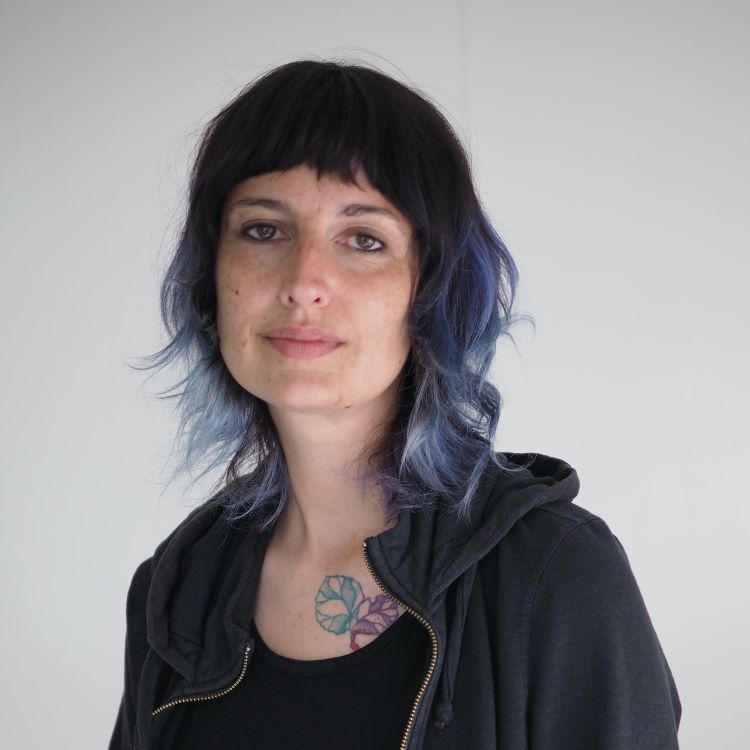
T. K. Rex
T. K. Rex’s science fiction and fantasy stories have appeared in more than forty publications, including Asimov’s, Grist, and their debut collection, The Wildcraft Drones, out this year from Stelliform Press. Their second book, The Cursed Blade of Wek, arrives in 2027. They live in San Francisco, co-host Stir: a seasonal reading series on Folsom Street, and spend most weekends at a local bookstore. T. K.'s newsletter, socials, and upcoming events can be found at tkrex.wtf.