
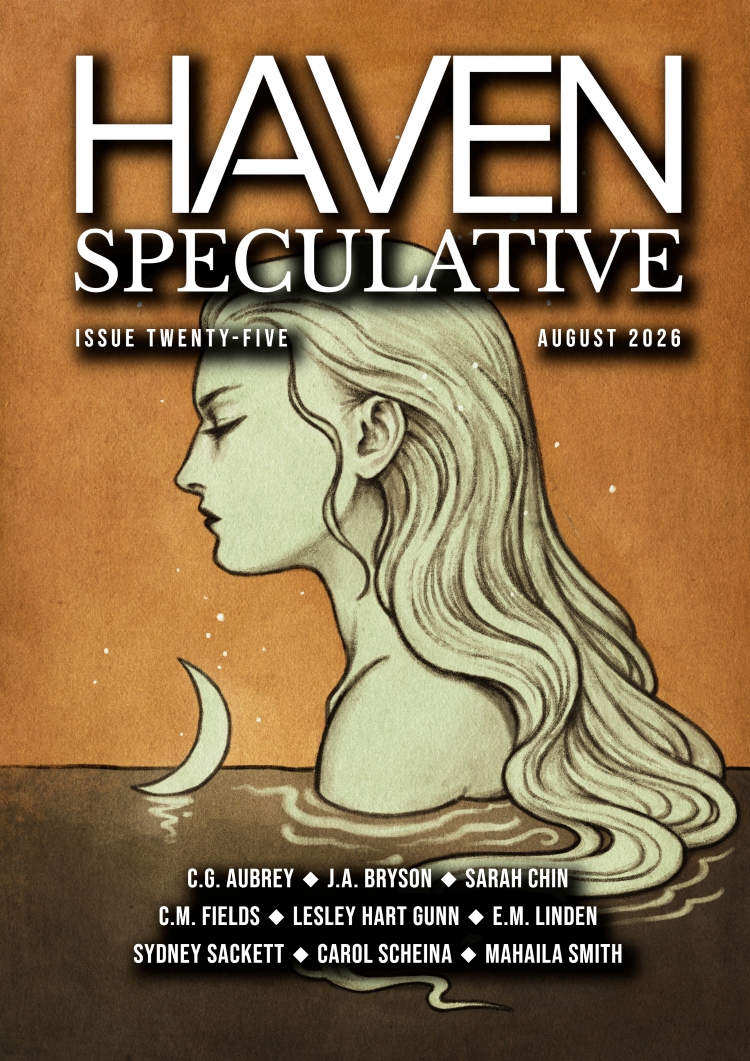
fiction
Like Water
by E.M. Linden in Issue Twenty-Five, August 2026
1355 words
In exchange for two large cod, the wise-woman extracts Minke’s first language and wraps it in a piece of sailcloth. Her milk-language, her mother-tongue. It’s only spoken here, on this chain of islands. Each of them a few acres wide, and each with their own particular accent and god.
The parcel shifts in Minke’s hands like a waterskin, cool and smelling of gutted fish. When she lifts it to her ear it calls back to her: gulls, the lilt of a bone-whistle, and under that, something crying.
The old people always say the language of Minke’s island is like water. Still, Minke expected something bloodied, the size of a heart or a tongue. Something ripped out. That is what the extraction felt like.
Everyone knows you cannot leave your island without seeking the blessing of its god. Giving it something in exchange for taking yourself away. Minke will ask for a safe journey and decent work on the mainland. Her mother-tongue is a good sacrifice. It’s precious but easily shed. Minke studied hard. She knows the mainland language well enough that she’s made her own language expendable.
Minke’s stepfather had known how to sail in any weather; the scalloping of the coast had been as familiar to him as his own knuckles and scars. He left for the mainland even so. He had three girls in the house who needed books for school and coats for winter and new shoes every year. His mainland wages fed the family, tarred their boat, kept Minke and her half-sisters in school. But now he’s nearing retirement, his body exhausted from factory labour. Now it’s Minke’s turn.
It’s a common story on the island. The skies are immense, but the seas are wild and the soil is thin, and it’s almost impossible to sustain a living.
Minke’s stepfather sacrificed his sea-craft. He won’t return to the island; he misses the sea too much. Be careful what you give up, he writes to Minke.
All very well, but Minke has two sisters. (Half-sisters, really, not that it makes any difference in how she feels about them. Her dad vanished back to the mainland before she was born.) It’s not like she can afford to stay.
When Minke gets home, she puts the parcel containing her first language near the hearth, like rising bread. Checks on it too often. She remembers her mother baking. Her clever, strong hands working the dough.
She runs her thumb over her mother’s silver ring, the finest thing anybody on the island owns. “Your father gave me this,” her mother told her. “A rich man, a mainlander. His name’s inscribed inside. That’s the only clue I have. Find his people; they’ll look after you.”
Her mother is gone. Her mother is still her mother. Minke rests her palm on the parcel. Leaning close, she almost makes out a lullaby. She can’t understand the words anymore.
It’s harder than Minke expected, without her mother-tongue. Every day she discovers new losses. Words with no equivalents. She’s lost the names for sea-winds, currents, constellations, fishing-knots. Her youngest sister’s namesake is a small, shy wading-bird that nests nowhere else but on their island. Minke’s lost the name for bird and sister both.
When she returns from the extraction, her grandmothers nod and cry and hug her. They wave their hands at the kettle, the fireplace they want stoking, the chowder they’ve kept warm for her. Already Minke misses Granny Tern’s ghost stories and Granny Thistle’s jokes. She’s a stranger in her own home, in broken communication with her own family. Her sisters haven’t learned enough of the mainland language to tease her, to quarrel or express affection. The middle sister, Fin, is a poor student. The youngest—the one whose name Minke has lost—loves school, but she has only studied the mainland language for two years.
Minke cannot sing with them. Only hum, wordlessly, alone.
Fin will follow Minke to the mainland next year. Together, with the blessing of their little island god, they’ll find work and send their wages back, keep their youngest sister in school, their grandmothers warm. Fin can’t give up her mother-tongue; she hasn’t learnt any other. Her first language is the only one she’s proficient in. She’ll sacrifice her knack for music instead. The only valuable thing she’s got. She plays anything: pipes, fiddle, bodhran, bones.
Minke is leaving in an otter year. Next year is a seal year, a good year for musicians. By then Fin will no longer be a musician.
Sometimes Minke looks beyond the heartache. Her mother was the only person she knew who went to the mainland for no other reason but to see what it was like. Minke takes after her mother: the part of her that befriends strangers, that watches ferries and horizons. She could thrive on the mainland. Leave and return like water. Not everyone can.
She worries for Fin. Can’t imagine her sister without music. Fin’s only herself when tapping her foot, shaping chords, whistling. Weaving her melodies through the winter evenings, starlight in the dark.
When she can’t put it off any longer, on the morning of the date printed on her ferry ticket, Minke scrambles down the rocks to the god’s cave. She tucks the parcel containing her mother-tongue awkwardly under her arm. Her hands shake. Tear-spots darken the sailcloth. She knows how the sea feels, reaching after the moon. Home pulls at her. She cannot turn away.
She can. She has to.
The sadness hits like a king-tide. A storm.
It will ebb, she tells herself. It will calm.
Still, she imagines running out of the cave, cradling her mother-tongue. Clambering back up the rocks. Giving up on her future. On her sisters, who need her. Would that, too, be a sacrifice?
It would. But not hers.
Deep in the cave is a rock-shelf, a natural altar smoothed by centuries. A seal’s face is carved above it. Minke listens to the waves murmur, the secret run of seawater through the cave’s rocky ventricles. Power wells up from the sea. It’s a good place for her mother-tongue to rest.
She places the parcel on the altar. It shifts in agitation, like water running backwards and forwards, sloshing in the belly of a rowboat. She hums one of Fin’s melodies to soothe it, and lays her hand on the parcel. It’s cool as seawater under her fingertips.
The notes of her sister’s composition fill the cave.
She can’t do it. Humming instead of singing; smiling blankly at her grandmothers’ stories, at her sisters’ laughter.
There must be another way.
She pulls off her mother’s ring. Weighs her future. The ring’s the only way to find her father’s family. Her family. A shortcut to belonging. She rolls it into the rock’s hollow, watches it spin and settle.
She could leave the ring instead. It’s valuable enough. She could take her mother-tongue back to the wise-woman, unwrap the parcel, welcome her language home. She wouldn’t be the first.
If she must choose between them—
She stops humming. The last notes of Fin’s melody fade.
Minke sighs. There is no choosing. Neither is enough. Not the ring and not her language; not for what she needs. Two blessings, one for Fin and another for her nameless sister. Two sacrifices.
It hurts like broken oyster shells lodged in her throat.
She touches her mother-tongue. “Let Fin keep her music,” she whispers. Then the silver ring. “Let me travel safely to the mainland so I can support my family and keep my youngest sister in school.”
The sea rushes in, over her feet. It sweeps the altar and swallows her sacrifices. There’s no other sign the god has heard her. No swell of music, no whale breaching outside, no seals singing in the harbour. All she has is a hope, certain as a memory. Her sisters, teaching her again how to speak their language like water. How to sing, how to say their names.
Her language is gone. Her language is still her language.
She walks out of the cave. There it is, the ferry’s bright wake, already coming in.
© 2026 E.M. Linden
E.M. Linden
E.M. Linden is a Nebula-nominated writer from Aotearoa New Zealand whose work has appeared in Strange Horizons, PodCastle, The Deadlands, on the Locus Recommended Reading List, and various other magazines and anthologies. She loves coffee, ghosts, owls, and the sea. She is online at @emlinden.bsky.social or emwrites@emlinden.blog.