
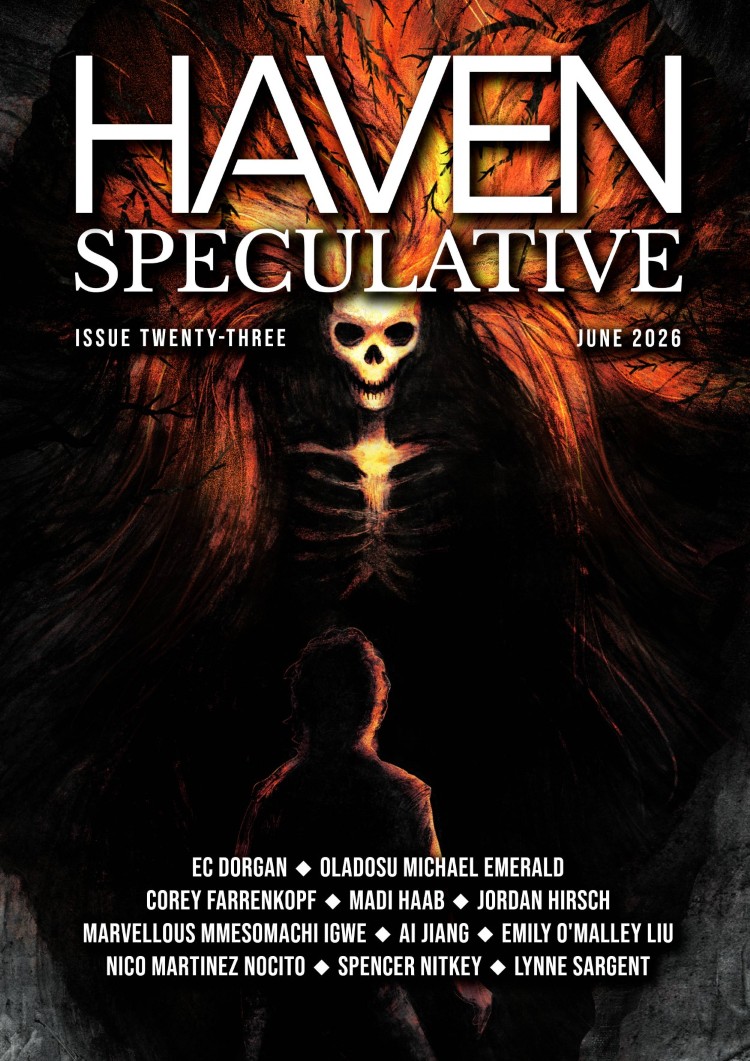
fiction
Mother’s Bane
by Madi Haab in Issue Twenty-Three, June 2026
3364 words
Edwin was an enthusiastic lover, eager to please and to pleasure. He kissed Briar all over, even the strange red bumps she’d first noticed on her skin that morning. His mouth was slow, then teasing, and he brought her to her peak—once, twice—as they made love.
After, they fell back on the mattress in a sweaty, sticky-sweet tangle. “You taste like honeysuckle,” he whispered in her ear before dozing off.
Those would be her husband’s last words.
Briar roused in the morning to find Edwin staring past her head, pupils blown wide yet unseeing. Unmoving. Unbreathing. She clasped his clammy shoulder and shook him hard, calling his name with increasing panic, but his head simply rolled from side to side on the pillow.
She must have screamed for help: she reached the door, dressed in a shift she didn’t remember putting on, just as it swung open. The village healer—her next-door neighbour—was there, and it was all Briar could do to gesture towards the bedroom.
The healer examined Edwin. She felt his throat, brought her ear to his chest, lifted his eyelids one at a time. Briar watched, scratching the bumps on her arms until they bled, vaguely remembering she’d meant to have them looked at.
“I’m sorry,” the healer finally said, then reverently smoothed the bedsheet over Edwin’s face. “He’s been gone a few hours.”
Briar stumbled to Edwin’s side. “No. No. He can’t be. He was—he was fine just yesterday. He can’t be—”
The words dissolved in her throat. She’d know him with her eyes gouged out, and the sheet failed to conceal his beloved features: the lips she’d kissed so often, his tall, proud nose, the shock of sandy hair sticking out from under the linen. She dropped her forehead to his, and her tears slid down her cheeks and seeped into the fabric covering his face.
Voices rose somewhere behind her. The village head was talking to the curious and concerned gathering at her door, but Briar ignored them until Edwin’s father pushed his way past the crowd and stormed into the room.
“My boy,” he cried. He was a large man, just like his son, and Briar was unceremoniously shoved aside as he rushed to the bed. Then he began to weep, stroking Edwin’s hair like he was still a little boy. “What happened?”
The healer twisted the hem of her sleeve. “As best as I can tell”—she cleared her throat—“it looks like … like poisoning. Nightshade, if I had to guess.”
The word itself poisoned the atmosphere, turned it noxious and suffocating. Briar’s fingers went numb—poison had been her mother’s province, and the reason Briar had left her and her baneful hybrids behind. The image of her mother sneaking into the house at night flashed across her mind. She pictured her cloaked shape stirring poison into the jars of jam and syrup Briar had made from her garden blooms, or towering over their sleeping forms to let a few deadly drops trickle into Edwin’s ear.
The thought of her husband dying next to her while she slept on, unawares, was unbearable.
Butterflies had flown through the open window and now drank the tears soaking the improvised shroud swept over his still shape. His father scattered them with an absentminded sweep of his arm; a few fluttered away, but others fell to the floor, dead or beating feeble wings. All the while, his gaze was trained on the kettle of chamomile tea gone cold that Briar had brewed the night before.
Then he looked at Briar, his eyes red and wild.
“You,” he said, stabbing a finger at her. “We took you in, and you took my son—my only son—from me.”
He took a step towards her, and Briar backed away, fear spearing its way through the grief. “Please—I would never—I love him so much—”
But he wasn’t listening. He pulled Edwin’s axe from its hook on the wall. The healer shouted a warning, and Briar raised her hands just as the blade whistled through the air.
At first she thought he’d missed, but hot liquid was spilling down her arm as four of her fingers scattered to the floorboards. She expected pain, but none came: she still felt her fingers attached to her hand, even though her eyes told her they were on the floor. Her brand-new wedding ring glinted in the crimson puddle, still hugging the base of her severed finger. Without thinking, she bent to pick it up, only for her maimed hand to sweep through the air uselessly.
The room spun around her, and agony shot from the empty space above her knuckles, bright and dizzying.
Eyes blazing, Edwin’s father adjusted his grip and hefted the axe over his shoulder. The crimson edge of the blade dripped with her blood, angled towards her like she was some blighted tree to be felled. A blur of people were shouting and jostling through the doorway behind him as he prepared to swing again, but Briar was cornered.
The healer snatched at his arm. He shrugged her off easily, but the distraction gave Briar just enough time to squeeze past him and escape. Clutching her maimed hand to her chest, she elbowed her way through the gasping crowd of villagers, tears blurring the last sight of her garden.
Then she fled into the woods, barefoot and bleeding.
#
The forest was a wash of green and gold around her. Roots clawed at her ankles, and branches whipped at her face. Briar fell, got up, ran, fell again, got up. She only stopped running when her legs refused to carry her any further, exhausted by the loss of her husband and of so much blood. Face down against the earth, she tasted moss and loam and something sweet like nectar.
If Edwin’s father tracked her down—and she had no doubt her trail was obvious—she’d never be able to escape him this time. Her best hope was the villagers talking him down, but she couldn’t count on that. She gathered the last of her strength to crawl across the forest floor and curl up in the crook of a large oak’s roots, with the vain hope it would hide her from sight. The bumps on her limbs had swelled like ripe buds and now oozed with clear fluid. Blood still dripped from the stumps of her missing fingers; she tugged the laces at the collar of her shift free, then used them to tourniquet her arm.
Birdsong and sunlight streamed through the canopy, too bright for the darkness in her heart. “Edwin,” she whispered to the forest. “I’m so sorry, my love.”
Briar had come to the village with nothing but the clothes on her back and the flowers she’d gathered to earn some coin. Edwin had asked for a bouquet that would charm a maid, then gifted her the spray of wildflowers he’d just bought. They’d been inseparable ever since. She’d tend to her flowers and herbs while he cut wood, and then they’d sell their hauls together at the nearby town market. Some villagers had been suspicious of her, not without reason, but Edwin didn’t care about the past she refused to talk about: all that mattered to him was the future they’d build together, with his axe and her garden shears.
Marry me, he’d said when she found the ring he’d slipped on a tulip bud about to burst open.
It had only been a few short moons since she’d first put on that ring, but in just a few hours, Edwin was gone, along with the life that had only just started to bloom in front of her. Withered like that blushing tulip, full of unkept promise.
By the time the sun reached its zenith, Briar roused from the exhausted sleep she’d slipped into despite her anguish. A headache throbbed behind her eyeballs, and she shivered in the bright sun, her face sticky with tears. She licked the corners of her lips and was surprised by the sweetness of her tears instead of the salt she expected.
Then she looked down at herself and shrieked.
The stumps of her fingers were—they were—
Blooming.
Blood now caked her hand and forearm like dried resin, and the stumps had formed little nodes of bone that already bore thin stems and coiled leaflets. The swollen bumps on her limbs had sprouted: thorns now jutted from her skin, sharp as any rosebush as they clawed at the muslin of her shift.
Briar leaned to the side and retched. Her empty stomach clenched until wet petals splattered to the ground, leaving a floral aftertaste at the back of her throat. She spat and scrubbed at her mouth; a thorn gouged her cheek, but she barely felt it.
That left her no choice. The only place where she might find answers was the place she’d run away from. It had taken her most of her teenage years to gather the courage to leave that wretched hut, and she’d sworn to herself she’d never set foot there again. That she’d never give her mother the satisfaction of crawling back. But if anyone knew what was happening to her—and what had happened to Edwin—it was her mother.
As much as Briar dreaded knowing, she needed to.
She stood on shaking legs, buds and thorns and all, and made her way deeper into the forest, towards her mother’s hut.
#
The sun had dipped behind the treetops by the time the hut came into view: first its smoking chimney, then its thatched roof, and finally the bright, blooming garden peering through the dilapidated fence. Ivy clung to the walls, and plants spilled over the flagstones leading to the crooked door. The same sprays of foxglove and monkshood that Briar remembered still swayed welcomingly in the cloying breeze.
“Mother,” she cried, banging her fist on the door, heedless of the flowering tendrils sprouting from her missing fingers. “Mother, please. It’s me. It’s Briar.”
The latch clicked, and the door groaned open. Briar had only been gone a year, but her mother looked like she’d aged a decade: the wrinkles ran deeper on her face, hardening her features, and silver threaded her dark hair. Meanwhile, she was studying the thorns sticking through Briar’s skin and clothes, the stems growing from her hand, the skin peeling back from her cheeks like peony petals.
A blend of surprise and relief lit up the woman’s face. “Come in, darling child,” she said, guiding her inside. “Let me look at you.” Briar had once reviled her touch, but she welcomed it now, desperate for comfort.
The hut was just as Briar remembered. Plants of all sorts rose from the floor, spilled from windowsills and hanging pots, even clung to the stones around the hearth. The perfume of flowers commingled with the medicinal smell of herbs and a sharp note Briar couldn’t place. Her mother, dressed in green and bark brown, almost vanished among her plants.
She cupped Briar’s cheeks and caressed the petals of skin curling away from the bones of her face. “Incredible,” she murmured. “You’re so beautiful.”
Briar sobbed despite herself. “What’s happening, Mother? What’s happening to me?”
“What happens to all flowers. You’re blooming, child.”
More things were happening to Briar’s body. Her flesh was coming unknit under her shift, and she wrapped her arms around her ribcage to hold herself together. “You … you knew? What did you do to me?”
Her mother’s smile was a cold scythe. Her eyes narrowed to slits. “I made you from cuttings and seeds, let them germinate in my flesh, watered them with my own blood. I feared you may not survive the transition on your own, but I needn’t have. This is your true nature, my darling.”
The thorns, the buds, the poison. Briar moaned as the truth dawned on her. Edwin’s father was right: she had killed him, poisoned him with her own toxic nectar.
“I killed someone,” she choked out.
“A man, I presume?” her mother asked, taking her usual seat at the table. She uncorked a vial and poured something dark and viscous into a watering pot. “Even flowers need to defend against predators.”
Briar’s stomach was still expanding around the swell of some tumorous growth. She doubled over, tightening her hold around her body. “Predators? He was my husband.”
Her mother stirred the contents of the pot with a ladle; multiple scars at various stages of healing peeked from under her sleeve. “None of this would have happened if you had listened to me and remained here. You only have yourself to blame.”
Memories burst through her mind like roots from the earth: the foul brews she was forced to drink as a child and the vehement assertions it was for her own good, the remedy to conditions she later suspected never existed. Her mother kept her isolated in the little hut, shutting her down when she begged to find other children her age, and keeping her hidden from sight on the rare occasion a lost traveller knocked at their door for directions. She still had recurring nightmares of topiaries and espaliered trees, except it was her limbs that were twisted into ornamental patterns.
It had taken her years to understand that her mother was the blight afflicting her, and even longer to find the courage to leave. But once she had, she’d never looked back. In the short year since she’d run away, her life had shone more brilliantly than she’d ever thought possible. At first, only a few bright spots of colour had emerged, like crocuses piercing the snow that blanketed the dormant soil of her existence—but before long her life was radiant with the bold reds, purples and yellows of summer blooms. Flowers whose fragrance she could breathe without struggling to catch her breath for hours afterwards, whose nectar and petals she could turn into tea, jam and syrup—sweet, delicate things that brightened the faces browsing her market stall. She’d discovered the joy of hearing her name in a crowd, of someone’s hand reaching for hers. Of being welcomed. Wanted.
She’d made friends. She’d found love. Found a man who saw her for what she was, not what she ought to be. A family who accepted her without question. Neighbours who inquired about her health and lent a hand without expectation. The future was a seed in the palm of her hand, a thousand thousand possibilities just waiting to take root.
She’d found her place, or so she’d thought.
Of course her mother would rip it away. The woman was a rot, a weed that choked the life out of everything around her, and her daughter’s budding happiness was no exception. Briar should’ve known she’d never be allowed to flourish, no matter how much distance she put between herself and the accursed mother plant she’d been cut from. The unfairness of it all made her want to scream.
And yet. Now that she knew what life could be, she couldn’t imagine taking any other path than the one that had led her here. Had she stayed, she would have withered and died, she knew, and so she refused to shoulder the blame her mother was casting at her feet.
What happened to Edwin was not Briar’s fault.
“If I’d stayed here you’d have twisted me until nothing was left except you.” Her voice cracked on the last word. “All I wanted was a normal life. To make my own choices.”
Her mother sneered. “What you want is of no consequence, Briar. You are my daughter. You belong to me. I made you.”
Briar’s hold around her torso was starting to fail. Her ribs cracked as they stretched outwards, unfurling like fronds under her skin, reaching out like the fingers of a splayed hand, like the fingers she’d lost to the axe of a man mad with grief. An ache halfway between pain and pleasure filled her body, some atavistic urge she couldn’t name and fought for that very reason. She was scared of what would happen if she didn’t—of what she could do, of what had killed Edwin—but she’d been scared all her life, and that had been no protection in this cursed place.
So she’d be the monster her mother had created.
“You may have made me, but I will unmake you,” Briar screamed.
She thought of Edwin again, the impending release of orgasm and the sweet surrender that follows, and let go. Her body bloomed in a glistening corolla of bone and flesh. Her ribs fanned out like the cilia of a Venus flytrap leaf, and her shift tore open, revealing the pulsing taproot that was her heart and the red, slick lining of her stomach.
Her mother rose, eyes wide with wonder, and smiled. “Oh, darling child, let me—”
Flowering vines unfurled from Briar’s abdomen. They coiled around her mother’s neck, squeezing the words from her throat. The smile was swept off her face; her hands clawed at the tendrils choking her, and Briar had the grim satisfaction of hearing her mother beg her for once, the words more breath than voice. More vines whipped through the air, and a sprightly, heady scent filled the hut as they lassoed her mother and lifted her off the floor. Then they were sucked back into Briar, and she caught a flash of white, terrified eyes as her mother disappeared into the ravenous hollow of her body.
Her ribcage snapped shut, her torso sealing over her prey, stretching her stomach tight as drum skin.
Past her heaving chest, her distended belly made her look like she was about to give birth. Briar sobbed once, remembering how she’d once dreamed of carrying Edwin’s children. Fitting, perhaps, that she now carried her own mother instead: she may have left the hut, but she’d never fully escaped it, had never put behind the dark seeds that had been planted inside her long ago.
Now alone, Briar sat down hard on her mother’s wooden stool. Inside her stomach, her prey’s futile struggle weakened, then ceased, finally overcome by the digestive juices and lack of air. Exhausted tears began sliding down Briar’s face. She had no one left now: Edwin was dead, she was anathema to the village she had called home for too short a time, and now she didn’t even have her mother to—
Something brushed her hand, pulling her out of her thoughts.
A delicate, leafy tendril wrapped around her wrist, then sought the stems burgeoning from the stumps of her fingers. The plants around her all stretched out towards her, like blossoms towards the sun, reaching for her with buds and leaves. No normal plants, these: silky tendrils of hair, spindly, finger-like stems, petals of vulvar purple-pink. Hybrids of plant matter and flesh.
Briar understood. These were the siblings her mother had been trying to make.
Anger surged through her, hot and bilious. Of course her mother had put others like her through this ordeal, condemned them to a lonely life of death and poison. She considered destroying them, burning the whole place down and never looking back. But watching the little buds swaying blindly towards her, like newborn pups with their eyes still closed, Briar was suddenly overcome with a rush of love so pure it hurt.
None of this was their fault: they hadn’t asked to be brought into the world, and they were no less worthy of life than she had been. They deserved the same freedom she’d fought so hard to obtain. The life she’d once dreamed of building may have been out of her reach now, but maybe—maybe she could still start the family she craved, turn this hut into a home instead of the prison she’d grown up in.
Briar hauled herself to her feet, retrieved the watering pot that her mother had filled with her own blood, and began tending to her sisters. Amidst their strange, swaying heads, she caught the first glimpse of a new path unfolding before her, different than what she’d envisioned, perhaps, but no less promising.
She would trellis these seedlings herself, and see what may yet bloom from her mother’s withered thorns.
© 2026 Madi Haab
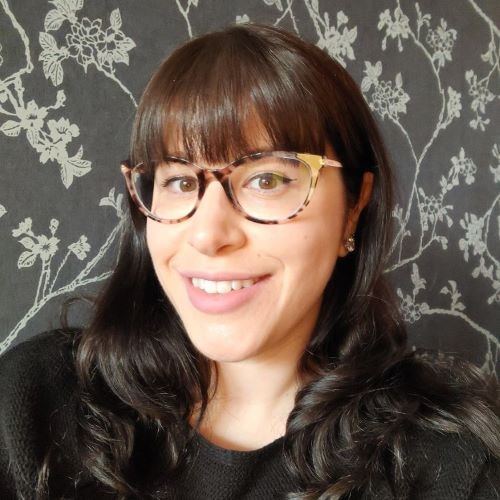
Madi Haab
Madi Haab (she/her) is a queer and neurodivergent writer and poet of Moroccan descent from Tiohtià:ke/Montréal. She draws inspiration from her mixed cultural heritage and identities to explore the liminal and interstitial. Her work has appeared in Augur Magazine, Haven Speculative, and Baffling Magazine, to name a few, and in 2025, she won the QWF’s carte blanche Prize and the Marina Nemat Award for Fantasy. When not writing, she dabbles in art and singing, and likes video games and afternoon naps a little too much. Find her at madihaab.com and on Bluesky @madihaab.com.