
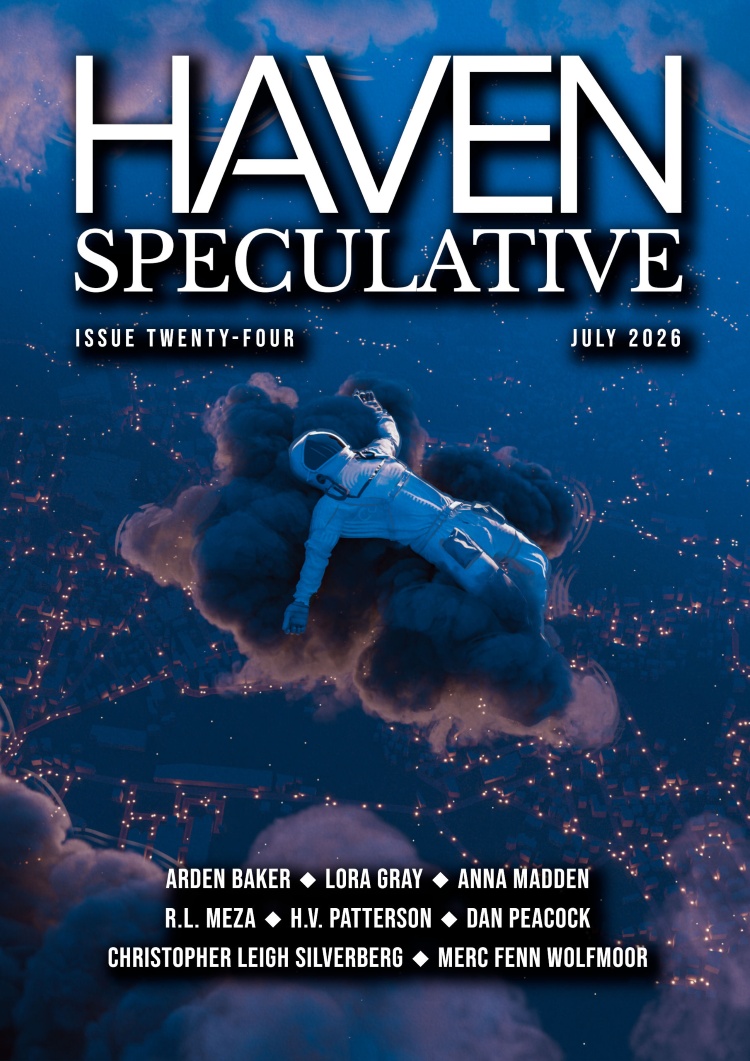
fiction
Pieces of Anna
by R.L. Meza in Issue Twenty-Four, July 2026
2510 words
It’s a funny thing, telling folks that my astronaut daughter was lost at sea—funny, like slowly pulling up a weed with a taproot anchored in my heart; which is to say, not very funny at all. But then, watching one’s flesh and blood descend from the upper atmosphere to scatter into a billion pieces takes a strange toll on a man’s sense of humor. Anna would have laughed to hear me describe it. Rolled her big brown eyes, then flashed that crooked smile that only ever showed a dimple on one side, as she told me I was worrying for nothing. The orbital repair mechs are safe. Astronauts have been riding them in and out of space for decades without incident.
Oh, my child, I would say. My sweet, darling Anna—light of my life.
Tragedy can befall anyone at any time.
It’s patient.
Random.
Look to the old man wandering the beach as evidence. See the slump of his shoulders, the way his head hangs, as if the thoughts cluttering his skull are too heavy to bear. Notice how he pauses to stir every tangled heap of kelp with his walking stick. Watch him overturn every twisted length of driftwood, face pinched with a mixture of dread and hope. As if his daughter’s remains could be hiding anywhere. Under the next grain of sand he shifts, or the one after.
If asked, he might tell you that lost is worse than dead.
The day of the crash, the crowds lining the beaches were so thick the sand was reduced to slivers. Sunlight sparkled on curled waves of jade. The air was crisp, the sky a vast blanket of blue cut in two by the line of smoke trailing down to the water. A beautiful day.
It should have been gray. Fog pulled close around the beaches, like a mourning shroud, obscuring the rescue boats. Water dark as liquid asphalt. Leaden clouds, roiling in the wake of a fallen angel. In Anna’s absence, the day had no right to be so beautiful. Not when it had taken everything from me.
Long after the boats returned to port, after the volunteers searching the beaches dwindled down to close friends, and talk of a memorial service began circling around, a storm tampered with the currents. The pieces of Anna’s mech began to wash ashore. I booted up my ancient computer to post online appeals, printed out flyers and plastered them all over town. Space had stolen my daughter when she was still a starry-eyed child, hectoring me to draw lines on her cardboard ship and affix plastic buttons and dials. But it was the ocean that robbed me of closure.
I knew we would never find her alive. The best I could hope for was something to bury at the base of the marble headstone that I couldn’t picture without breaking down. But I was a good father to Anna; I tried my hardest.
I deserved a chance to say goodbye.
And so, the search parties returned to the beaches, spread over miles of coastline to bring back what they could.
Anything, I told them. Anything and everything.
Not knowing how much remained to be found.
The largest pieces made the papers, magazines, and the evening news. One of the mech’s legs survived intact; a full-page color photo showed twin brothers standing grim-faced atop the rocks where the twisted metal had become lodged. Like the brothers, most of the finders had the decency not to smile. These were not victories, but salvage.
The volunteers were locals, and locals knew better than to comb the beaches alone in winter. Ten miles up the coast from the leg, a mother-daughter pair found half of the mech’s chest poking up from the sand. For the duration of the interview, the mother kept glancing over her shoulder at the wreckage, the scorch marks on the dangling panels, the battered framework trailing kelp in the ebbing tide. Her arm remained locked around her daughter’s shoulders, as if she might float away.
An elderly couple found Anna’s seat on their evening walk, with the help of their gull-chasing terrier. In the photo from the front page of the local paper, the pilot’s chair sat upright, facing west, like it had been brought there to witness one last sunset. Fading light limned its dripping silhouette. But the seat was as empty as the seashell fragments littering the shore.
Twenty-three somber teenagers formed a half circle around the mech’s charred helmet for a group photo. Years before, Anna had visited their grade school to deliver a presentation on the invention that would one day bury her beneath the waves. She must have made quite an impression; though the subsequent years had split her audience between different high schools, the students reunited to join the search. In a documentary covering the incident, one shy young woman showed the camera her college acceptance letter, said Anna had written her a recommendation and offered to mentor her. Anna kept up correspondence with all of them—helped whenever she could.
I offered rewards to the finders, but no one would take them. My attempts to pay for the reclamation efforts were politely refused. Anna’s former shop teacher ran a rental business—tow trucks, flatbeds, excavators. A classmate from college offered his legal services, should the company come calling for their lost property. Volunteers swarmed the remnants without hesitation or complaint. The sweat of our community brought my daughter’s mech home to my farm, laid the pieces out in a field bordered by redwoods and firs.
As I wandered through the skeletal, disjointed remains, I saw my sorrow reflected in the crushed metal, the bent and broken parts. I believed my grief was trying to kill me. Truly. Some nights, I prayed it would.
But the work was far from over.
The small pieces came next; their collection outlasted the news cycles, the winter and most of spring. Gnarled driftwood stumps ensnared wires and safety restraints. Netting snagged on barnacles. Shredded strips from the parachute fluttered like white flags, urging us to surrender. But we refused. Countless winking bits of metal filled buckets and bins. Hands of all ages and colors unfurled like blooming flowers to reveal their found treasures. Unable to rebuild my damaged features into anything resembling a smile, I nodded as I accepted their findings.
In those days, I hunted alone. I kept my back turned to the ocean, hoping the crashing, rushing waves would take me by surprise. Praying for a riptide to drag me under and out to wherever the endless gray water was hiding my daughter. In those days, I screamed at the waves to give my Anna back.
They gave me everything but.
Haunted by possibility, I combed the beaches without rest. Dense fog blurred the driftwood, smoothing organic curves into prone human forms. From a distance, lumpy masses of kelp hinted at something more. I once encountered an olfactory illusion so terrible, it took an eternity to summon the courage to approach, so certain was I that the seal corpse was Anna, that the flesh the gulls were feasting on was hers.
Various scenarios plagued my thoughts. If I found her, would I—driven mad by love—attempt to resuscitate her, knowing full well she was gone? Would I gather her into my arms and carry her back to my truck, the way I carried her up to bed as a child when she fell asleep on the couch?
Would there be enough of her left to hold?
I tried to remember her as she was. But the specter of my daughter as she must be now, eclipsed my former memories. Anna was everywhere. I glimpsed her face in rock formations, heard her voice in the cries of the gulls. Breath of brine, a whisper carried on the wind. I spun, expecting her to emerge from the pampas grass wearing a lopsided grin. As if it had all been a joke at my expense.
I longed to laugh with her the way a drowning man longs for air.
As she must be now, I would have loved her still. Looked upon her readily, if given the chance.
Just to see my Anna again.
When the found pieces dwindled down to nuts and bolts and screws, I left the beaches for the field. It was time to rebuild.
But the community wasn’t finished with me yet. They brought me might-be and could-be pieces, and when those ran out, they brought home-cooked meals and takeout. They sat and coaxed and prodded, reminding me the building would require strength. And so, the hollows between my ribs filled out; the color returned to my cheeks. I ate, slept, ate, adopting a numb routine. Not because I wanted to live, but because it was required of me.
For the build. For Anna’s machine.
In addition to food, the community fed me stories. As the twin brothers turned steaks on my charcoal grill, they told me how they hadn’t spoken in years. After the crash, one reached out to the other, neither having anyone with whom to explore a hazardous cove that had yet to be searched. While they clamored over the rocky piles, each watching the other’s back against the treacherous surf, the tension between them dissolved. In the shadow of the salvage they found, the argument that had driven them apart was forgotten.
While she tackled the unwashed dishes in the sink, ignoring my protests, the teenaged daughter apologized that her mother couldn’t be present. Shortly after finding the mech’s chest piece, her mother entered a rehab program; she flushed the ocean of prescriptions she’d become lost in down the toilet. She wanted to be around to watch her daughter reach adulthood. To stay with her, protect her for as long as possible.
Watching the elderly couple’s terrier roll over to earn a French fry, I learned their evening beach walks were a recent development. In the wake of her husband’s diagnosis, the search had rekindled the old woman’s sense of purpose. Discovering the pilot’s chair sitting up in the sand had felt like a sign, she told me, that the sun would continue to set and rise, despite the fear confining her to their cottage. She took comfort in knowing the world would go on, with or without her permission. That there was still time to go with it, to experience new sights and sounds and feelings, with the man she’d shared her life with for fifty years.
Of the former classmates who came together to find the mech’s helmet, seven formed an online group to remain in contact. They ran fundraisers in Anna’s name to assist with the costs of building supplies my pension couldn’t cover. These bright-eyed youths invaded my humble farm with their boundless energy and frightening optimism, hellbent on repairing anything they could get their busy hands on—and never mind that I couldn’t pay. Never mind that I often marched outside to chase them off, only to find myself asking about the outcome of a challenging exam or a football game. Our conversations were like echoes from the past, an opportunity to dust off all the advice I’d once given to Anna, and regift it to a new generation. The photo above my fireplace—seven teens covered in red paint, grinning before a revitalized barn—became a lifeline in my darkest moments.
And so, when the rebuild began I was not alone. I was opening up, sharing pieces of Anna through the stories I told. The community understood my determination, seized upon it to make it their own. They built scaffolding, brought tools I didn’t have, safety equipment. And meals, so many meals. But never once did they ask to touch the salvage, or insist on participating in the rebuild. They could not say goodbye for me. That task was mine alone.
My daughter loved her mech more than life itself. I could never make it fly again; I’m no mechanic, no engineer. But I could make it stand.
I would make it stand.
For her.
It felt fitting, somehow, that there were not enough parts to return the mech to its original form. Without Anna—our heart—neither man nor machine could ever be whole. But we made do, from the ground up. I got busy. The missing pieces would require salvage of another kind. Sacrifice, if you will.
The heavy steel frame from Anna’s first car, stowed in the garage for her visits back home, served as the mech’s missing leg—an unsightly, off-kilter addition, though functional enough. Her childhood bedroom was just as she’d left it. Entering that sacred space pulled the breath from my lungs, squeezed tears from my eyes. Curled inward as I was, I was surprised to feel a foreign sensation rise up within me: resistance. Not the will to live, but the need to persist.
To finish.
I laid hands on the metal bed frame that had been black until my wife passed away, shortly after Anna’s ninth birthday. Anna had returned from the funeral—arms crossed, jaw set—and declared she’d had it with black; only bright colors for us, from here on out. I was but her humble servant; Anna pointed and I painted. By transforming the farmhouse with a kaleidoscope of colors, we chased the shadows of grief into the corners. We learned how to smile again.
The prosthetic arms arching from the mech’s shoulders are neon rainbows visible from the highway. People honk when they drive past. I like to think the sight brings them joy. Every spring, I climb up to add fresh layers of paint to the arms, and I can almost see Anna nodding her approval. It doesn’t matter that the arms look nothing like the originals, so long as they are bright. LOUD.
Anna’s mirror hangs alongside the pilot’s chair mounted in the mech’s open chest. Folks used to say Anna was the spitting image of me, a miniature clone with pigtails. If I let my eyes drift out of focus while I’m sitting in her seat, it’s like she’s sitting beside me, alive in my peripheral.
The mech is a tribute, a timeline, a testament to a life lived fiercely. Its body is faceted with memories—a patchwork of furniture, mementos, trinkets, and trophies—hand-molded to fit the rough shape of Anna’s first and only love.
Like her mech, my daughter was born for the stars.
I wish I could tell you this story ends with a miracle. That, once completed, the mech moved of its own volition and took flight, guided into space by the spirit of my lost daughter.
But this is not a fantasy.
For over a decade, Anna’s mech has stood tall in the field. It is standing there still. Waiting for a tired old man to take his seat, to finish saying everything left unsaid to his little girl, his world. A lifetime of words.
The only miracle here is closure, and I’m not ready for that yet.
But the miracle will come.
Anna, my darling child, I promise.
© 2026 R.L. Meza
R.L. Meza
R.L. Meza is the author of Our Love Will Devour Us (Dark Matter INK, 2023), with stories in Clarkesworld and Nightmare Magazine. Meza writes speculative fiction from a not-haunted Victorian house on the coast of Northern California, where he lives with his husband and the strange animals they call family. Learn more at rlmeza.com. Follow @rlmeza.bsky.social.