

fiction
Strawberry Island
by Emily O'Malley Liu in Issue Twenty-Three, June 2026
3177 words
We were boys when we met by the seashore. He threw a stick at me and called me ugly. I tackled him into the sand. We became inseparable.
His name was Angelo. For fourteen days, Angelo and I met as if by preordination at dawn, on the beach behind my family’s vacation rental on the southern Maine coast. The tide in the bay went out, out, out, and so did we, scouting across the massive expanse of wet, freshly revealed earth, hunting in the tide pools that formed between the rocks, seeking out belligerent crabs and docile sea stars, collecting stones and shells and sea glass. Decades ago, a hotel on a bluff had fallen into the sea during a storm, and you could still find bits of glass and porcelain that the water had run smooth, some of it patterned with blue-and-white china prints. I asked Angelo how he knew about the hotel and he said that his dad had told him, which struck me as a good enough authority. Certainly better than my own father, who, when asked about the hotel, had removed his glasses from his face and slowly polished them on the hem of his shirt before answering.
“I don’t know, son. Could be.”
There was an island out in the middle of the bay, Angelo told me. You could get to it on foot when the tide went out: a small copse of scraggly trees, maybe thirty feet across and a hundred feet long, which was just the right size for a pirate ship. Strawberry Island, Angelo called it, for the wild strawberries that grew there in the summer. We clambered up on the rocks and looked out over the domain we terrorized. In the distance, the cold edge of the Atlantic glimmered. Angelo pointed, and I watched as two sleek bodies porpoised out of the water, silver arcs gleaming in the sun. It was the greatest two weeks of my young life.
Until the last morning, when I went out to the beach and Angelo didn’t come. My mother said his family must have gone home. It had never occurred to me that Angelo might not live here. He knew so much about the bay, how to find strawberries and dolphins and tide pools. I couldn’t picture him in a house with his parents, warm and dry. He seemed made of the water.
I didn’t return to the bay until decades later, when I came vacationing with my own husband and children, who were the kind of kids who had been kept inside and sheltered. They were more comfortable reading a book on the sofa with their grandparents, which was where my husband and I left them and walked out to the beach, hand in hand like newlyweds, toes sinking into the mud-sand. I had been so excited to show him the way the water receded out across the great bay, to explain the tide pools and the island that stood there in the middle of it, just like in my memory, though when we made it out to the island, there weren’t any strawberries.
“That’s pretty great, hon,” my husband said.
Back at the cottage, he scooped up the kids from my parents and read them chapter books on the back porch. My parents took a nap. And I went back to the beach alone.
I don’t know what I was hoping for—or rather, I knew exactly what I was hoping for, but didn’t know how it could be possible. I was waiting for a boy with brown skin and dark hair scraggly with wind and salt, muck between his toes and bits of seaweed clinging to his swimming trunks. But that boy was long gone, and even if he had, by some miracle, returned to the bay this summer too, he would no longer be a boy. We would no longer recognize each other.
But still, I walked. The tide was out, and I crossed the whole length, out past Strawberry Island, out to where the cold Atlantic caressed the muck. The sun glinted ferociously on the water, and I put a hand up to shade my eyes as I peered out, like a pirate. In the distance, three dolphins jumped, three perfect, synchronous arches.
My mind always quieted when I walked. My husband understood, in his patient gentleness, that my need to walk was greater than it ever had been. It was part of why we had come here—a seaside vacation for my health, like an ailing Victorian woman, and not an otherwise healthy man in his forties with an anxiety disorder. The drugs worked, but they worked better if you kept moving. So I moved.
The tide began to shift, and I was forced to up my pace. Had this once been effortless? My sandals, rubber things that slid around on my feet, didn’t help. I missed the water shoes I’d worn as a kid, which had allowed me to scramble over rocks and sharp shells without ever missing a step. My calves burned with the instability, arms pumped in an effort to keep my body upright.
When I made it back to Strawberry Island, I heaved myself atop the largest rock and sat a while to catch my breath. When the tide came in, the island would be marooned in the middle, a proper island, unreachable save by boat. I scanned the horizon. The dolphins were gone, probably out hunting for their supper. I would be overdue for mine if I didn’t get a move on.
I slipped down off the rock and landed much harder than intended. My stupid, useless sandals went out from beneath me, and my ankle turned hard in a direction it wasn’t meant to go.
“Damn.” I tried to get to my feet and nearly fell again. I was forced to put my hand against the rock to steady myself. I held the injured ankle above the surface, knee-bent like an injured sea bird. I tested my weight again and was rewarded with a shock that ricocheted up my calf. I gasped in pain and nearly fell again, but a strong hand pressed up beneath my bicep and hauled me suddenly upwards.
I would have screamed—I had thought I was alone on the island—but the pain had stolen all my breath. Whoever it was held me steady and sure, waiting for me to find my balance. An angel, not an assailant.
I looked up, which required me to blink into the sun, and my first thought was that my rescuer was some kind of wild man, a New England Tarzan. He wore a wet suit, and his black hair fell to his shoulders in salt-crunched waves.
But—there was something about him that was familiar. A sense of deja vu, of walking through your own front door when you haven’t been home in a while, and you notice the smell.
“Angelo?” I whispered.
He grinned—a wide, maniacal grin that showed off most of his teeth.
I laughed, pulling him in for a one-armed man-hug. “How the hell are you? Do you live here now? Or wait—did you always live here? I’m on vacation with my family—we’re staying just up the beach.”
He smiled and nodded, then gestured at his throat.
“Oh,” I said. I tried to remember if this had been true when we were children. Surely, Angelo must have spoken to me, if I knew his name? If he had told me the secrets of Strawberry Island? But it was too long ago for me to recall the sound of a voice. “I’m sorry, I never learned any sign language.”
He shrugged and nodded again. Then he grinned that same wide, charming smile that reminded me of an animal somehow, like a dog when it’s happy to see you. He pointed out to the water line, which was creeping closer and closer. He cocked his head and gestured with an elbow.
“I’ve gotta get home for dinner,” I said. “I have kids—they’re eight and five—and we like to have dinner as a family.” It was important to my husband. It was important to me. It was why I walked, dammit.
Angelo stood up and held out his hand. He was wildly handsome, bronze skin glowing in the late afternoon light, eyes like stars that blinked out of his sculpted face. And his hand, calloused and strong, wrapped around my fingers like he was my guardian angel.
I put my injured foot on the ground. The pain was like lightning. “Fuck,” I said. “Oh, fuck.”
Angelo guided me back to my rock, then knelt and took my foot in his hands. The pain disappeared once I took the weight off, and his touch was gentle. He moved my ankle back and forth, and it went smoothly, apparently unbroken.
“Maybe it’ll get better if I just—sit here for a minute.”
He looked up at me, concern etched in his face.
We were two hundred yards from shore. If I couldn’t walk, what would I do? Swim back? Ask Angelo to carry me? Those biceps were promising, but he wasn’t much bigger than I was. Could he carry someone his own weight that far?
He spread his palms and gestured downward for me to stay and then strode to the opposite end of the little island and clambered up onto the biggest rock. He moved like a sailor, loping with confidence over a deck that swelled with the sea. He put a hand over his eyes and looked out over the water. Like he was looking for someone. Had he come by boat?
That made sense, I thought, relieved. It would explain why I hadn’t seen him walking earlier, if he had come from the water side, jumped off the side of a boat to say hi to an old friend.
Angelo came back to sit next to me and pointed at my ankle. I tested it gingerly on the ground. I was still afraid to put weight on it, the memory of that lightning still fresh in my nerves, and I shook my head. He nodded, then looked back out to sea.
The water line crept closer. Angelo took my hand and squeezed. He didn’t seem worried, and strangely, neither was I. Perhaps I’d be marooned on Strawberry Island all night with a handsome man. Surely that was one of those situations that even my husband couldn’t get mad about?
The minutes lapped past. It occurred to me that I was desperately thirsty. The thought of spending all night on the island lost its appeal.
Angelo poked my ribs with a finger. I squirmed, and he laughed, the sound surprisingly high-pitched and giggly. He pointed down at the rocks between our feet. Wild strawberries, tiny and red, peeked up through the crevices. He reached down between our feet and collected a handful of them. We ate them out of his palm, tiny explosions of too-tart wild fruit that chased away the worst of the thirst.
When the water was nearly kissing the far end of the rocks, I turned to Angelo. “Alright,” I said. “Time to make a decision.”
He stood up at mock attention and saluted. I laughed and slid off the rock. The pain flared, but I grimaced, trying to at least be brave about it.
And then I was in the air, swept up into strong arms.
“I don’t—Angelo!”
He held me in his arms like a toddler, like I weighed nothing at all. Had I thought his biceps impressive? His chest was a brick wall. I could feel the hardness of his pectoral muscles pressing up against my considerably softer shoulder.
He walked towards the water, steps steady and sure, barefoot on the sand. I put my hands around his neck. He grinned that same wide-open, happy grin that showed off all his teeth. At the water line, he didn’t stop but kept walking right into the gently-lapping waves. “Angelo?” I said. “Where’s the boat?”
He shook his head.
“What do you mean?” I demanded, feeling suddenly frightened and more than a little stupid. Perhaps this wasn’t Angelo at all, but some kind of serial killer who convinced unsuspecting people that he was a childhood friend before tossing them into the Atlantic.
Again, I thought of screaming, but a wave broke over his knees, dousing my back in freezing spray. I gasped, just in time for another wave to break. The water was at his thighs—his hips—my back—
And then his arms were gone and I was in the water, tossing and spinning like a baby struggling to be born. The water was cold—not the kind of cold that you could get used to but the kind of cold that sank its claws into you and lingered. Angelo had a wet suit; I had nothing but my shorts and shirt. I found my footing and straightened, sputtering. “What the hell, Angelo?” I shouted. Or I would have, if my voice had been able to rise above a shake.
Can you stand?
“I—” I tested my weight again, carefully. I was half-floating, the water up to my chest, and my footing on the bed of the sea was light, gentle. “I think so, but—wait. I can hear you?” The words sounded idiotic even as they came out, offensive and surreal. But Angelo only grinned.
In the water, he said.
I stared up at that grin. His hand slid over my bicep, and I shivered. “Who are you?”
He pulled me by the arm, leading us deeper. My shirt smocked against my cold skin, outlining the worst of my melting physique. After the kids had been born, I had slowly become accustomed to eating their leftovers off their plates. It had been hell to keep up with any sort of exercise regimen other than my physician-prescribed walking, and I felt a surge of embarrassment at the idea of Angelo, beautiful Angelo, seeing me like this.
But Angelo wasn’t looking at my body. His eyes were on mine as he pulled me slowly into deeper water. He actually could murder me, I thought vaguely, and I would just go along with it. Angelo grinned, like he knew what I was thinking.
I won’t hurt you. I promise.
“My f-family,” I said. My teeth had begun to chatter. The water was up to my shoulders, my toes losing purchase with the sand. “Up on the beach.”
He glanced towards the shore, at the little green cottage that stood on the bluff, and nodded. Trust me, he said, and then he disappeared beneath the surface, as though pulled under by some monster from the deep.
“Angelo!”
But when the surface broke again, it wasn’t a monster. And it wasn’t Angelo.
It was a dolphin—a huge, smiling dolphin.
It had never occurred to me that dolphins are, in fact, quite large animals. Large and wild. The creature in front of me must have been five hundred pounds at least, and a fission of unease bubbled through my veins.
Angelo grinned, showing off two rows of sharp, perfect teeth. Then he rolled to his side and held out a pectoral fin. Put your arms around me.
I didn’t want to—he was terrifying—so instead I wrapped my arms around myself and bobbed in the water like an idiot, shivering so much now that I was practically convulsing.
It’s alright, the dolphin said. I won’t hurt you.
I had trusted him as a nine-year-old, when we went traipsing across these beaches, and I had to trust him now. I wrapped frigid fingers around the proffered pectoral and slid the other arm under his belly, holding his polished body close to mine.
He was cold. Of course he was cold—his heavy skin came into contact with the open Atlantic, his vital organs and blood protected beneath a layer of blubber that kept him warm. No mammalian warmth for me. But beneath my body, Angelo began to vibrate. Subtly at first, but picking up in speed and intensity, like he was shivering, and the shivers caught my flesh up in them, and soon I was vibrating too, and we shook and shook until all the cold was thrown off, and I felt warm and safe against his sleek body, as though I were held by a man and not a dolphin.
Are you ready? Angelo’s voice radiated up my arms.
Ready for what? I asked. I no longer seemed to need my voice. I could speak through my skin.
To go home, he said. The tide is nearly in.
My ankle—
You won’t need your feet. Would you like an adventure?
He moved—slowly at first, a long arcing circle, testing my balance and grip. And then his body tensed, and we shot out into open water. I dug my fingers into his skin, sure I would fall off and be left behind. But I didn’t fall. I couldn’t fall, not when I rode on the back of a lightning strike. Angelo picked up speed, more than I would have thought possible, and I laughed, the salty spray landing on my tongue.
We swam out towards the horizon that teased and feinted and beckoned, up to Mother’s Beach, down towards the inlet. We flew past fishermen’s boats, Angelo banking away so that no one would notice a human riding on the back of a dolphin.
An adventure.
I wasn’t a father, or a husband, or an employee or an adult with a chore list as long as my arm and anxiety that was always, always pressing. Twenty-five years evaporated in the sun, and in that man’s place was a child.
And it was—familiar. A dance routine my body remembered, a room I knew how to navigate in the dark. A person I remembered how to be. A hotel crumbled into the sea, dishes and windows and silverware turned to seaglass and treasures in the harsh salt.
Angelo made a joyful lap around Strawberry Island. Waves crashed against the larger rocks, saltwater spilling over the sides. It was a miracle that wild strawberries grew there at all, I thought. The tides that made playgrounds for children, the dolphin on whose back I rode—it was all such a miracle.
Near the shore, Angelo slowed. It was shallow enough here that I could stand and try to haul myself on hands and knees to the beach. I slid off and stroked his back once, feeling both foolish and grateful.
Thank you, I said.
In response, he only grinned. Then he turned tail and was off. Against the horizon, two other grey bodies leaped and arced.
My husband paced along the grass that backed our cottage, looking out over the water. His posture was rigid with anxiety, and his handsome face was terrified. He must have thought I’d drowned, I realized, and my heart swelled for him, for our family, as I watched him waiting, waiting, waiting.
I’m coming, I thought at him, and the words sounded like dolphin-speak in my skin. I’m almost home.
© 2026 Emily O'Malley Liu
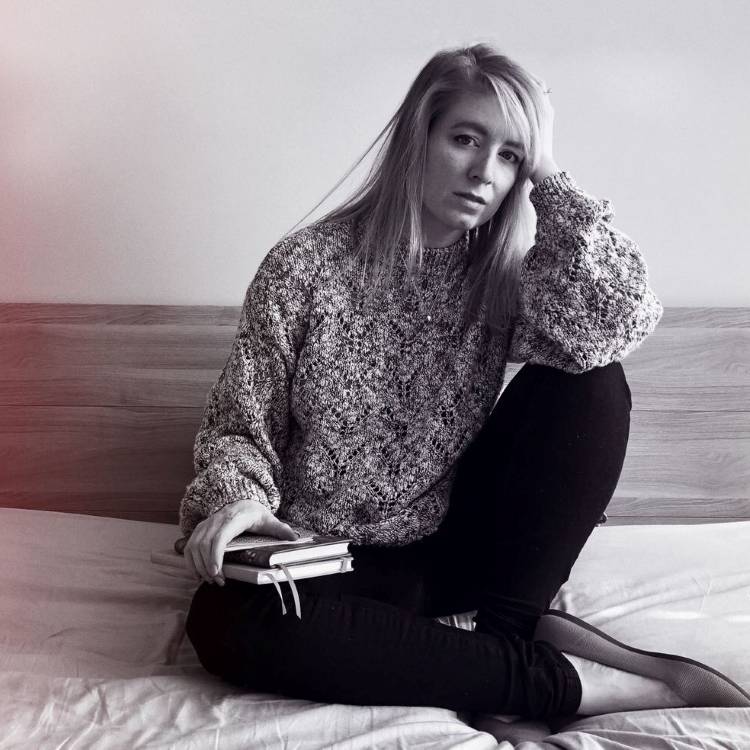
Emily O'Malley Liu
Emily O'Malley Liu grew up in Palm Beach County, Florida and has lived in the American Southwest, the Midwest, New England, and Japan. She currently resides in the greater Washington, D.C. metro area with her husband and three absolutely ungovernable kids. Her short fiction has appeared in numerous venues, and her first novel, WINE FOR ROSES, was published by Shiraki Press in April 2026. Find her online at www.emilyomalleyliu.com or on Instagram @emilyomalleyliu.