
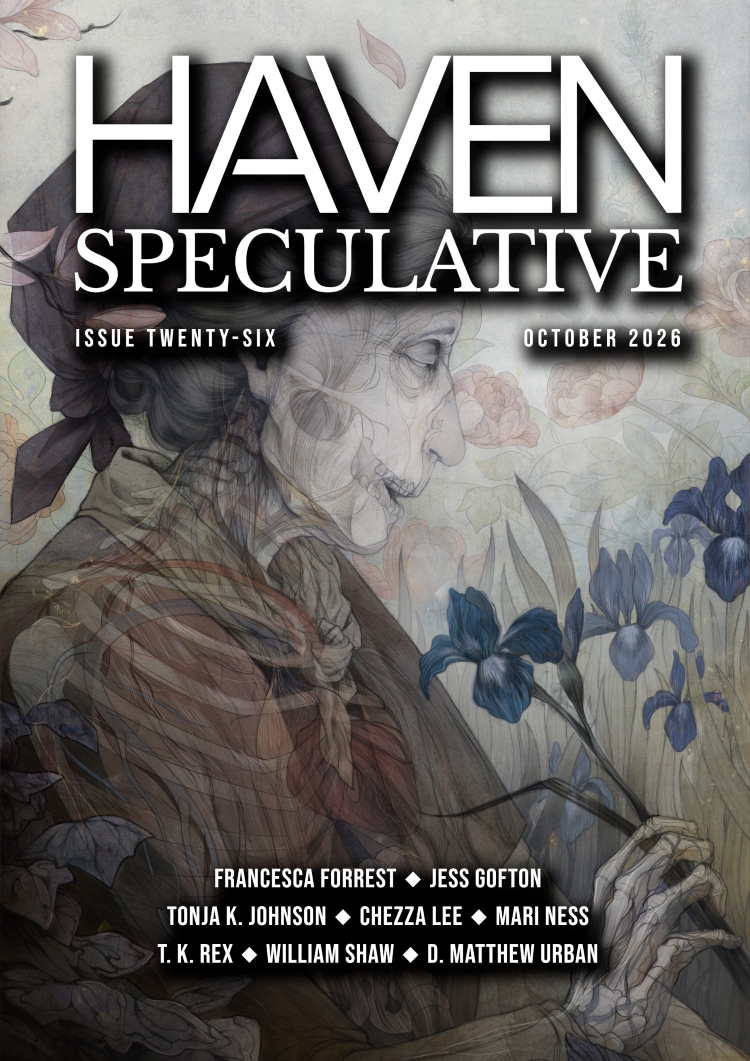
fiction
The Ladder
by Francesca Forrest in Issue Twenty-Six, October 2026
1352 words
There are four jugs of water left.
“We’ll share it out cup by cup. When there’s only a cup left, we’ll share it out thimble by thimble. When there’s only a thimble left, we’ll share it out drop by drop.”
Mother says this serenely, like it’s a beautiful thing.
“And then more water will appear in the last jug . . . or in the thimble?” my little brother asks. Because in the stories she used to tell us, this was so. The kindhearted man shared water with a saint in disguise, and from then on his canteen was never empty. A traveler shows up at the house, and the family shares water, and from then on, their jug is always full.
“Whatever happens, we’ll face it together,” Mother says.
That answer doesn’t satisfy us.
Everyone else in the community has left. They’re following the muddy trickle that used to be our river. Water seeks water. Back when there was school, the teacher said our river flows into another, and that river joins another greater river that flows into the sea. When the government stopped delivering water, our uncles and aunts and cousins set out to find someplace where the trickle is still a river.
Not us. Mother said we’d stay here until Father returned.
But I doubt Father’s ever coming back. He went off a year before everyone left, looking for the birthplace of our river, our trickle. But that’s the direction the drought came from, reaching down from the mountains, out of the north, out of the west. The drought refugees that passed through our community when I was little always came from the north and the west. But Father had some idea in his head, some feeling in his heart, so he went off in that wrong-direction way. At night, when my brother and mother are asleep, I cry a little sometimes, thinking about him.
Sometimes my brother stabs a long stick into the mud by our trickle, stab-stab-stab, and I think he’s remembering the stories Father would tell about catching fish, back in the days when our trickle was a river.
The fish that remain are tiny, the size of my littlest finger. You mustn’t eat them: everything in the trickle is poisonous now. But in the mud there are skeletons that show how huge fish used to be. The bones that spread from their spines are longer than my foot.
There are bones spreading out from my spine too: my ribs. I can put my hands on my sides and feel them like the ridges in a piece of corrugated metal.
We need to do something, or our bones will end up in the mud with the bones of those big fish.
I think there may be water hiding deep, deep underground. Maybe if we dig, we can get some that isn’t poisonous. So I find a spade and I start digging, not too near our trickle, but not too far either, because too far and the ground won’t let the spade in. The work just makes me thirsty, and Mother frowns. “Stop wasting your energy,” she says. “We don’t have water for that.”
Soon we won’t have water at all. This is the season for rain, but day after day, a bright blue sky glares down at us, not a cloud in sight. The sky is the same blue as the plastic tub Father used to fill with açaí berries when they were in season. He’d scale those skinny palms, cut the heavy clusters of berries, and bring them down. Now when there’s a breeze, the dry brown fronds of the açaí palms rustle like a snake’s hiss, ghost voices of trees that died of thirst.
Sometimes a cloud does dare to form. Sometimes rain even falls for a few minutes. We have buckets to catch it. Mother gives this water to the cassava and the guama in her field. It’s too late for the plantains—they’re ghosts now too, like the açaí.
We need more water than the cassava and the guama do. And when the dry season comes, it may be that no rain will fall at all.
There’s a plant that spread through Mother’s field when the drought first came. Snatch weed, she calls it. I’m picking its leaves—Mother says they take away hunger—when my brother comes up to me.
“I have an idea about water,” he says. “You were trying to dig for it, but what if instead we make the sky let go of more?” He stabs the air over his head with his stick, stab-stab-stab.
“We can’t reach the sky,” I say. “It’s too far up.”
“What if we climbed the lookout tower?”
The lookout tower is in the center of the community. It’s as high as four houses stacked on top of each other, stairs in a spiral up to a wooden platform, open to the air. From the platform you can see all the houses, the school, the church, the meeting hall, the fields, the forest. You could see the river, when it was a river. Now, you can see the trickle and its wide shores of mud.
I’m doubtful. I’ve climbed the lookout tower many times, and the sky seems just as far away up there. But my brother looks so hopeful. And what do we have to lose?
So we climb.
Back when there was school, kids used to brag about how fast they could get to the top. I wasn’t the fastest, but I wasn’t the slowest either. But now, climbing, I feel weak and breathless. My brother struggles too. We reach the top panting and thirsty. Mother won’t be happy.
My brother has tied a fish knife to his stick. Once he catches his breath, he looks up at the blank blue sky, then at me. He doesn’t seem so hopeful now. But he stands as tall as he can and jabs his stick at the sky. When nothing happens, he hurls it with all his might. It arcs in the air and comes down on the dusty road below. The sky is as unwounded as ever.
“I can try,” I offer. I’m two years older and a whole head taller.
“We need the ladder,” he says.
I’m surprised. The way he says it, he sounds so certain. Like Father when he set off upriver. Serene, like Mother, ready to welcome whatever comes.
The ladder’s still leaning against our house from when Father was putting a new roof on. We take it, retrieve my brother’s stick, and go back to the lookout tower. This time we climb more slowly. I carry the front of the ladder, my brother the back.
On the platform, we lean the ladder against the guard rail. Half its length sticks up into empty air.
“You hold the ladder steady and I’ll climb,” I say, my heart in my throat. “I’m taller. I can reach higher and throw farther.”
“I can’t hold your weight,” my brother says. “You’re stronger. You hold the ladder for me.”
I have turned into a coward and bad big sister, because I agree to this. My brother climbs. I tell myself I am an iron clamp keeping the ladder in place, but my arms quiver from the strain. The sun is high; my brother is a black blot against the blue.
A breeze rests its fingers on my forehead, brushing away all my troubled thoughts.
It could be that below, Mother is shouting up at us, but maybe it’s the ghost palms, whispering their same old stories.
The strain melts from my muscles. I feel very calm because now I understand something. My brother, the ladder, me: together, we are a tool with a purpose. We are the spear that will pierce the selfish sky. We are the blade against its throat, and here we’ll stand until it bleeds its waters down. The sky has its endless blue, but we have our sharpness and our need. We bring our life, our forever, to this challenge. How can the sky resist us?
The ladder shakes. My brother flings his stick.
© 2026 Francesca Forrest
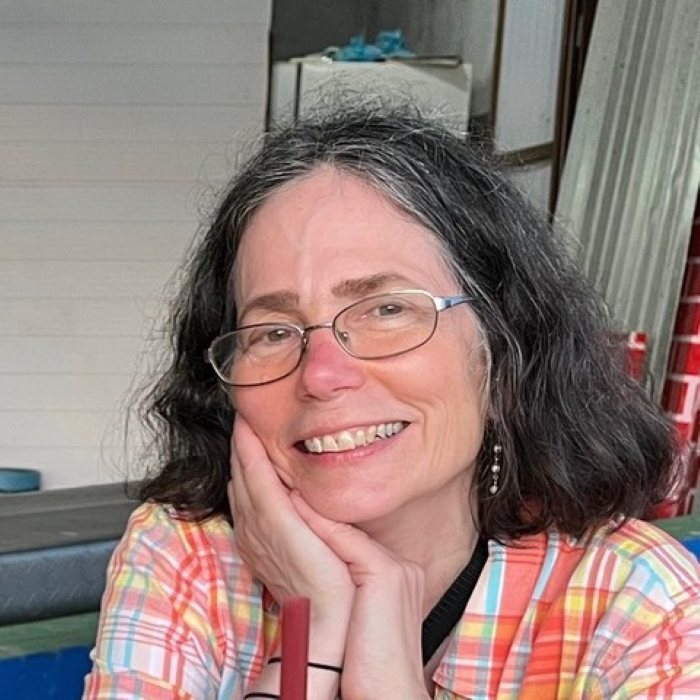
Francesca Forrest
Francesca Forrest is the author of the Tales of the Polity, which include The Inconvenient God (2018), Lagoonfire (2021), and A Flash of Scarlet (forthcoming 2027), all from Annorlunda Books. She has also published a number of short stories, including “Semper Vivens” (Andromeda Spaceways, 2024), “The Bee Wife” (self-published, 2025), and “The Road from Windy to Dragonroot” (Luna Station Press, 2026). She enjoys learning languages and would like to learn a word or two in yours.