
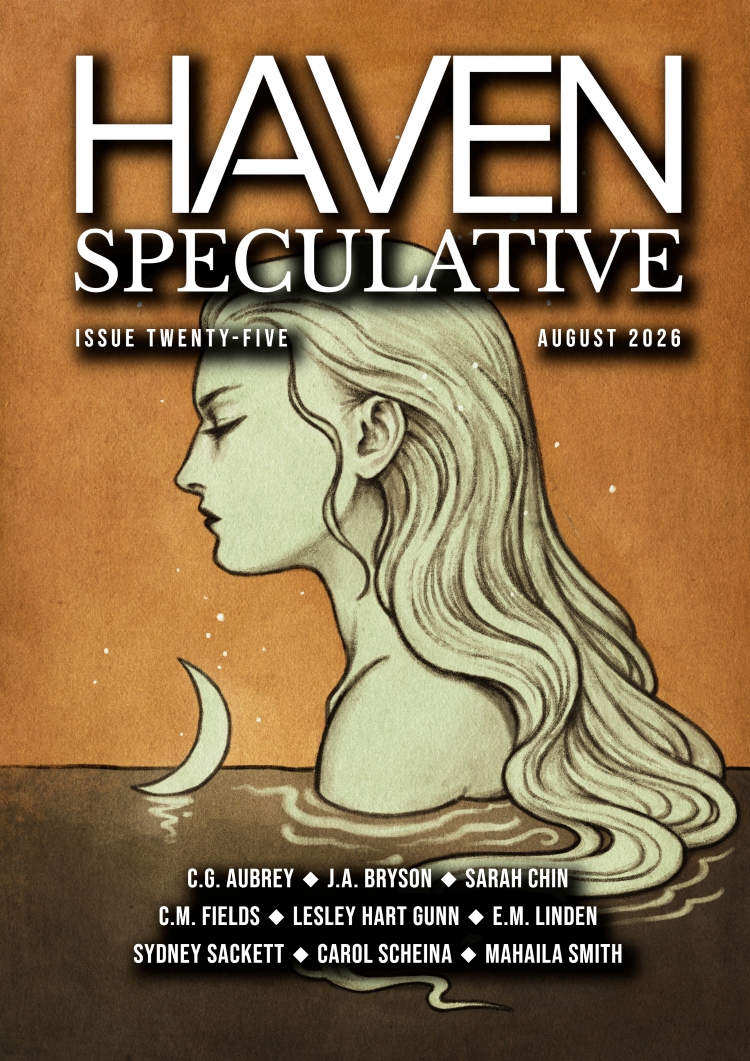
fiction
The Singers
by Sydney Sackett in Issue Twenty-Five, August 2026
1802 words
The anomaly was narrowband, centered at 1.3 gigahertz. Our automated minder had flagged a layered whisper of static from the Goliath system. I yawned and tipped back coffee dregs before I keyed a command to slew the telescope off-axis. If it was interference from our own satellites or aircraft, like always, the signal would remain.
Instead, it vanished.
I rubbed my eyes. Three AM at the observatory. Every intern had their own Wow! signal moment on too little sleep and too many fantasies of reenacting Contact.
Another command returned the disc’s focus to the system. The spike came with it. No telltale blips of prime numbers, no Fibonacci sequence—it was a shadow of a signal, degraded by fifteen light years of interstellar dust and plasma. But I was awake by then.
I copied the raw spectra and timestamp logs, hesitating before forwarding them to my program director. I still expected the observation to fall through under real scrutiny. Before I could close my laptop, Dr. Delaney pinged back.
Don’t leave. Omw.
She arrived half an hour later with her own coffee in hand, boots printing the control room floor with morning condensation.
“Let’s see it again,” she said, settling into the chair I’d vacated. The whisper was still there, faint but structured. A ripple of language from a low-mass exoplanet, Elhanan. We’d never marked it as a likely candidate for life: though spectroscopy indicated liquid water, the atmosphere was low in carbon dioxide, methane, and ozone, and F-type Goliath blasted it with sterilizing UV. We’d detected no familiar red edge reflectance of photosynthesis. Yet something was speaking from its surface. Delaney drew a slow breath, gazing at the spectral plot.
“I need to make some calls,” she said.
It wasn’t long before other senior analysts arrived. All the terminals were occupied, everyone wanting to confirm the readings. Scientists I’d always regarded with awe scrolled through my own data with shaky hands. Dr. Shaan clapped my shoulder. Chatter filled the room until the signal itself was drowned out.
“Everyone, calm down for a minute,” Delaney said. “You all know this, but I’ll make it very clear: we only contact other observatories for now. We need to verify that it isn’t just noise. We document everything. Keep logging, keep plotting, and keep it quiet until we know what we have.”
My chest tightened. This was bigger than any theoretical detection exercise we'd run through before. The faint technosignature had crossed fifteen light years to reach our array, and now it blared from every screen, igniting hope in veteran analysts who had endured so many years of a silent universe.
“And don’t forget who made the first call.” Delaney’s indication turned all eyes toward me. I flushed, ducking my head to the flurry of congratulations. The night seemed hallucinatory. Was it possible my name would be attached to humanity’s first reception of an extraterrestrial message? It was too much to contemplate. It would turn out to be another fantasy, an astronomical footnote. Not intelligent life.
I was only nineteen years old.
The announcement came a month later. By then, every major array on Earth and in orbit had confirmed the signal from Elhanan. Independent teams ruled out pulsars, solar flares, and all the false positives we could conceive of.
They stood me on the back of the stage for the press conference. Dizzy and barely breathing, I gripped my wrist behind my back and listened to the Director General’s speech.
“We believe we are not alone.”
Within days, the world’s governments had convened emergency sessions. Budgets rebalanced overnight, missions reprioritized. For the first time in half a century, funding for space exploration was a flood, not a struggle for scraps.
The first return transmission was drafted along the same timeline—an international committee of premier linguists, physicists, and diplomats met in Paris to devise our opening words. We still hadn’t deciphered the intent of Elhanan’s messengers, now Singers in the popular dialect, but we would send our best and hope to be understood. A cascade of equations, the periodic table, a greeting of peace in every earthly language. It pulsed from our biggest dishes in unison, stitched into a coherent beam aimed at Goliath. If we received an answer, it would take at least thirty years.
But we weren’t leaving the promise of first contact up to a song and a prayer.
The project entered the headlines as “Joyeaux.” A probe to Elhanan that would carry an automated lander and a radio downlink, borne by solar sail across the parsecs. Through laser propulsion, we could accelerate it to a maximum of .3 c. The most optimistic projection for arrival was over fifty years. The data it sent back would span another fifteen. Many of its engineers would never live to hear from their creation.
Selfishly, I was elated that I would. I was determined to. My name was already bound to Elhanan in history.
The combined efforts of global space agencies constructed Joyeaux in three years. A gorgeous craft, buttressed by an ablative Whipple shield to protect her from relativistic impacts. Her lightweight reflective sail unfolded to hundreds of meters. I watched her ascend the sky, squeezing Dr. Delaney’s hand numb until the announcer marked the launch successful. We screamed and hugged and wept. Across the world, the scene was the same.
The Singers had changed everything.
I defended my dissertation with Joyeaux’s trajectory emblazoned across slides. At the graduation ceremony, distinguished professors shook my hand with something like reverence. They introduced me to visiting faculty as the ‘Singer girl.’ As though I’d sung that wave into existence myself rather than absently checking it on an insomniac night shift.
The reputation followed me into my first lecture halls. I taught astrophysics to undergraduates who nudged each other and whispered: She’s the one. She found the signal. They asked more questions about Elhanan than galaxy rotation curves or Doppler shift. Some stayed after class to press me about what I imagined the Singers looked like, what their yet-indecipherable song meant, what we might learn from Joyeaux’s landing. I gave them careful, professional hypotheses, as though I wouldn’t have been one of them too, starving for the magic of alien life.
Less than a decade out, the sheen had dulled. Students no longer entered the classroom wonderstruck by my identity. Their questions were on exam weightings and extra credit. Joyeaux was far out of sight, and out of mind to most. We had received no answer to our transmission—Elhanan’s song continued without pause, a rippling hum that frustrated all efforts at translation.
But I kept a terminal busy with it. I could have plotted it by heart. I would remember it throughout my life.
Every year, on the anniversary of the detection, Delaney, the SETI team, and I raised our glasses at the observatory. We were the few who kept running countdowns, marking all occasions by their points along Joyeaux’s timeline.
I gave keynote addresses, sat on committees, buried old friends and mentors. Close friends joked that I was saving myself for a Singer. I never did marry. I’d always found the most comfort in the quiet, gazing at the stars. On restless nights I pictured Joyeaux’s sail still gleaming in the void, millennia of starlight catching her silver skin.
In the fiftieth year from launch, Joyeaux was set to deploy her secondary magsail for braking. Two years later, if all went well, she would land. Delaney and Shaan were no longer there to celebrate. I poured champagne for myself and a handful of other dreamers.
The Singers, too, would know they were not alone.
I am eighty-nine, and my joints ache with the weather. My aide assists me slowly to the observatory by night. A team of enthusiastic young scientists greets me. So many new names and faces. I am the last of us who watched the probe’s launch. A subparagraph in history.
An intern gasps at the readout on her screen.
“We’re getting a transmission from Elhanan,” she says. “Joyeaux’s data packages. It’s going to be hours until the arrays integrate them.”
I smile and sit. I’ve waited a lifetime. Hours are nothing to me.
We receive spectral plots, chemical composition, grainy images.
No industrial pollutants. No structures. No signs of sapients.
Only trees.
They are majestic metallic spires, crystalline seedpods sprouting from their dusty bases and fracturing light. High above, they don’t bloom with leaves, but expand into broad, concave plates that tilt to follow their sun. From the lander’s view, geometric drones on translucent silver wings chip away the seeds with mandibles like forceps. Their passage stirs glittering particulates in the ionized atmosphere. Clear water laps at a glassy shore.
The song is all around Joyeaux, nearly overwhelming her sensors with its intensity, and yet there are no machines to emit it.
The Singers are the forests. Their chorus is blind adaptation for an ecology of metals and pollinators which evolved to sense them. Elhanan’s charged ionosphere served as a natural cavity, enhancing the frequency until it was strong enough to reach us.
Had I suspected such a system when the Singers failed to answer us, proved impenetrable to interpretation? In the back of my mind, maybe. To witness it proven at the end of seventy years is another thing. The exclamations and arguments of the scientists around me are muted. I close my eyes.
We’ve found life, but not neighbors. Not intelligence.
But they called us, all the same, and we came to meet them. And I think I can love them still, these living radio dishes under a scouring star, singing their lifecycles away.
Joyeaux’s lander will scan and transmit to us autonomously, charged by Goliath’s light, as long as her lifespan permits. There is one more step in the mission she has already carried out, instructed by the onboard AI.
Using her small reservoir of solid fuel, she launched a protected capsule of Singer seedpods, attached to a graphene vane which unfurled in orbit. The TARS, a torqued accelerator using radiation from the sun, spun and built up speed until the payload was launched at a sub-relativistic velocity toward Earth. It won’t arrive on the scale of any human lifetime—centuries, even millennia, will pass, and I have hardly a decade left.
But I will have been part of the song.
There will be a day when stranger, wiser humans receive this gift from Elhanan, and take the seeds into their laboratories. They’ll use our data to craft a home for them. They’ll plant the Singers, and a new world will propagate their signal.
They never meant to reach us. Their voices were for themselves, their pollinator drones, their sunrise. Just as our signals ring through space, a lonely choir of humanity’s faults and redemptions.
Perhaps we too will be heard.
© 2026 Sydney Sackett
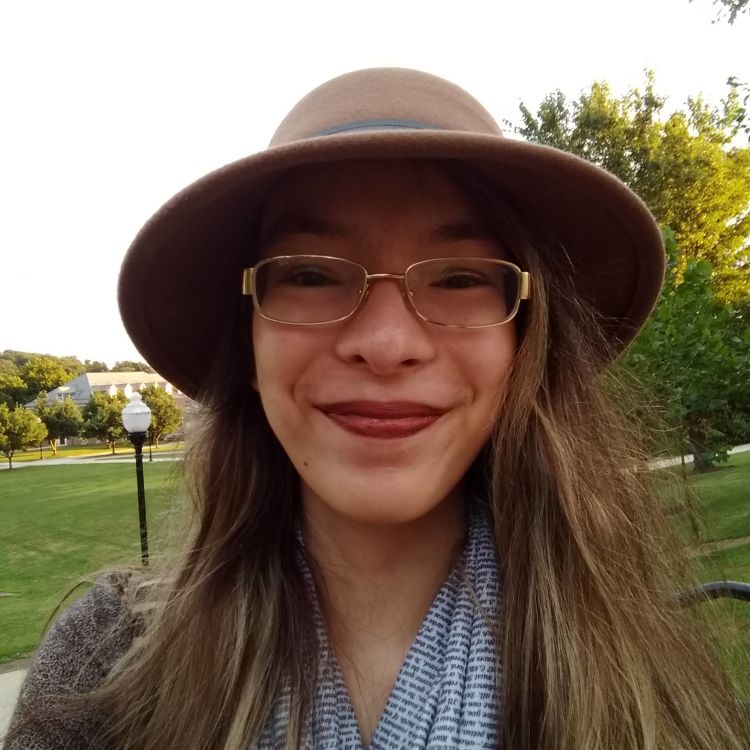
Sydney Sackett
Sydney Sackett (she/her) is a Frostburg State University grad and currently edits full-time. Some of her creative work appears in Etherea, Androids and Dragons, Allegory, and Not One of Us. She can be tracked down to https://sydneybsackett.wixsite.com/website.