
fiction
Tring-a-Ling
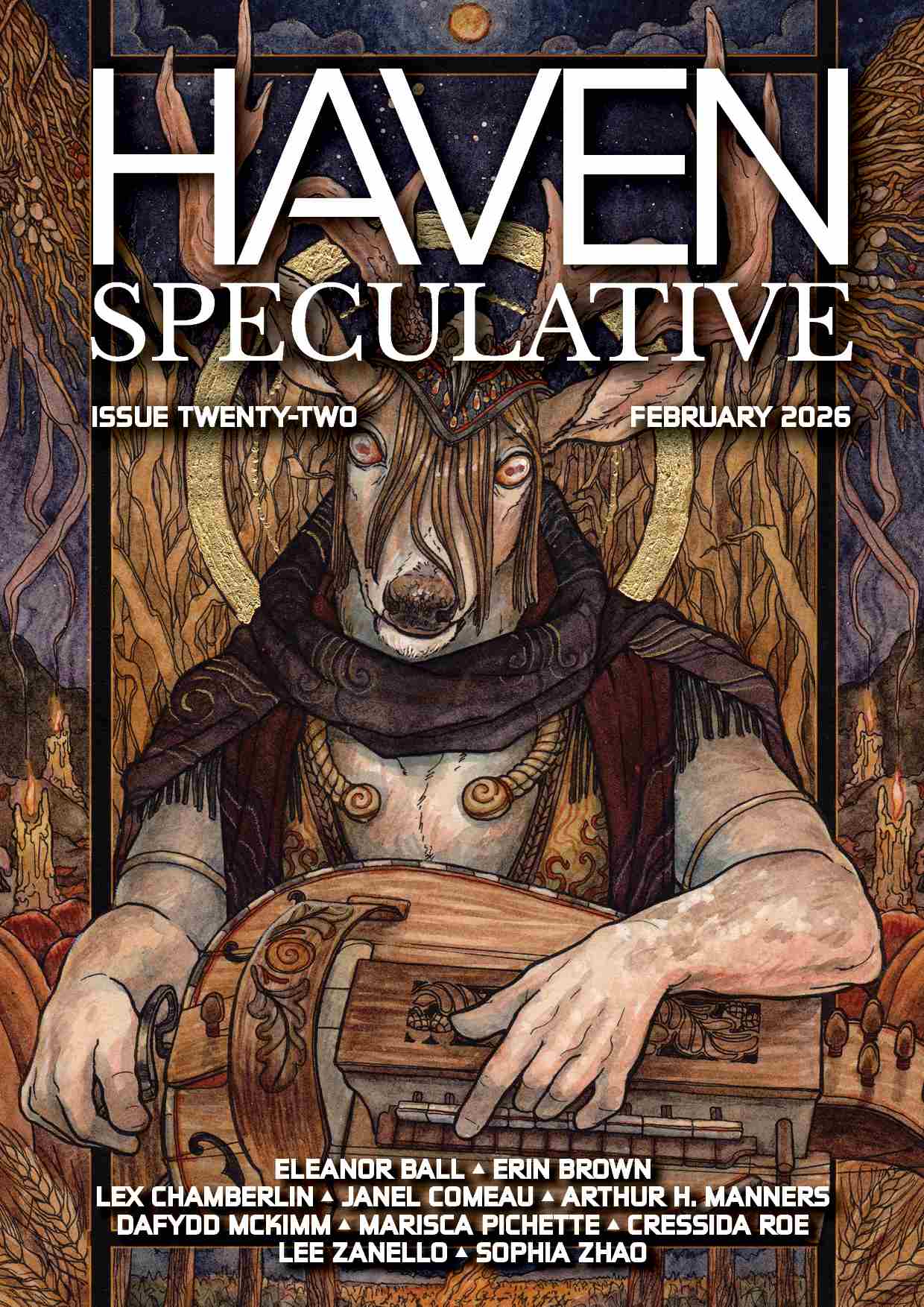
by Dafydd McKimm in Issue Twenty-Two, February 2026
1500 words
The Monster pedals into the village on a bright yellow bicycle, red tassels streaming from the handlebars, stabilizers clattering on the cobbles as it rings its bell—tring-a-ling, tring-a-ling—past the first of the well-kept houses.
Mrs Griffiths, scourge of aphids, rain-goddess to hydrangeas, spots it as it passes her gate, arrests it with a "Hello there, young man. Where have you come from?"
To which the Monster, face aglow, angelic in the sun, replies in a voice like a cherub that it is not allowed to talk to strangers; apologies if that appears rude.
"Not at all, young man," Mrs Griffiths replies. "Would that the other boys in this village had an ounce of your common sense. On you go. Don't let me delay you."
And so the Monster pedals onwards, ringing its bell—tring-a-ling, tring-a-ling—announcing its arrival to the houses on the way—hiding nothing, nothing at all.
At the next house, where sparrows and Jenny Wrens and multi-coloured finches dart and squabble over the nuts on Mrs Williams's bird-feeder, the Monster pauses outside the gate and fires peal after peal through the open window, sending the curtains fluttering and scattering the birds from their banquet and bringing Mrs Williams running out of the house crying with her bull-whip voice, "What is all this racket about?"
To which the Monster kindly asks in its nightingale voice that she please not snap at it; it is only a little boy after all, who is wondering only if perhaps she has anything for it to drink; it has been riding its bicycle all day, and today is such a hot day.
"Give the boy some squash, Mollie," calls Mr Williams from his armchair by the window. "Lad's got a thirst on him."
They watch it drain the squash in one long draught, before, with a satisfied gasp and a dazzling smile, it hands back the glass and is on its way once again, thanking them ever so much for their kindness.
"What a well-mannered boy," Mrs Williams says to her husband. "If only our Philip were half as polite."
"Good set of gnashers, too," said Mr Williams. "Not like that set of old piano keys our Gareth has got in his head. Shows good discipline, a good set of teeth."
The Monster pedals on, heralded by the tring-a-ling, tring-a-ling of the bell and the flutter of the red tassels on the handlebars, to this house and the next, all along the thoroughfare, beseeching from each a small kindness: here a biscuit, here a plum from their tree, here a flower from the garden; all oblige, saying how well he speaks, how nicely he conducts himself, how bright and wide his smile, and if only their Michael, or Lewis, or Julie, or Rosie had such good manners—how they could do to learn a thing or two from such a nice young man.
And when finally the Monster reaches the church at the end of the way, careful to stay out of the gates and avoiding the long spear of shadow cast by the steeple, it rings its bell louder, louder, until the vicar bursts from the vestry door, his cassock billowing like a thundercloud, and red-faced and blustering cries out: "What's the meaning of all this? Philip Williams, is this your idea of fun? Have a care, young man—the Lord's wroth will surely fall on thee...!"
To which the Monster replies that it is not Philip Williams, and it is very sorry for the noise, but would the Reverend mind if it took shelter from the sun underneath the yew tree, whose branches overhang the fence there. And leaning over the fence to address him, the vicar, taken aback by the Monster's politeness, says "Of course! Of course!" before noting its face and remarking that he hasn't seen it in his congregation here, nor in the congregation of the neighbouring parish, which is also under his stewardship. "Who are your parents, if I may ask?"
To which the Monster replies that, though it's sure the vicar means well, it is not supposed to give information like that to strangers.
"No, no," says the vicar, nodding in agreement, "quite right, my boy. Good for you."
In the dappled light beneath the yew's tangled branches, the Monster's eyes appear to smoulder. Are there, it wonders, by chance, any other children around here? It would like someone to play with; it is, as the vicar can see, all alone.
"Oh yes, there are plenty of children," says the vicar, "but on a fine day like this they're likely out on the hills somewhere." And seeing the Monster turn pensive and sad, the vicar conjures an idea—"Perhaps I could ring the church bell for you—the sound of it, so strangely on this day and at this time, will bring them running home to see what in Heaven is the matter."
Would he really do that? Really? the Monster asks, the smouldering in its eyes blooming like embers brought back to life by a breeze.
"Yes, with pleasure."
And soon enough the church bell is tolling, its peals rolling over the hills and fields, leaping dry-stone walls and hedgerows; and the children, ears pricking at the sound, are tempted home.
"The bell's ringing."
"Maybe there's a fire."
"Maybe someone's dead."
"Let's go and have a look. Quick!"
And Philip and Gareth, Michael, Julie, Lewis and Rosie, the Rowlands twins, the Evans sisters, like fish darting towards the centre of a ripple, run to the churchyard, to the Monster's welcoming arms and the vicar's half-sung adjurations, clear and loud as the peals of the church bell. "Children, we have here a lost lamb. Welcome him to your flock, as Christ welcomes you into his loving arms..."
Addressing the children, the Monster says that it would very much like to play with them; would they mind awfully if it joined them in their games? But something about the Monster makes them tarry: its smile, though it appears amiable and wide, has altogether too many teeth.
"Is there no one"—the vicar laments—"no one who will extend a hand of friendship to this boy?"
And spying through her window, and seeing her children's silence, Mrs Williams races to the gate and cracks her bullwhip tongue, shouting, "Philip and Gareth, shame on the both of you. Where are your manners?" And following her lead, Mrs Jenkins steps out: "Julie Jenkins, I'm disappointed in you!" And Mr Rowlands: "I thought I taught you boys better than that! Now you let this young lad play with you or I'll have your guts for garters!"
And the Monster, with a mischievous tenor to its voice, one that promises danger and adventure and hidden secrets, tells them it knows where there's a birch wood where the trees have leaves made of real silver, and a canyon where a real dragon's skeleton lies hidden in the undergrowth—it's true; it can show them all of it; they just have to follow along behind.
"There you are," say their mothers and fathers. "Go along now with this nice young lad."
"And if you don't come home for supper—well, never mind."
"We'll make an exception this time."
"Since you're with someone so sensible..."
"And so careful..."
"We're sure you won't come to any harm."
And suddenly the children can hardly believe their luck, because they are never allowed to stay out so late, and they have always suspected that there might be dragons buried in the canyons and that silver grew on trees; and with the rare gift of their parents' blessing, how can they refuse! In glances back and forth they commune with one another—We can always ditch him later once he shows us all the secrets; we can always ditch him.
And so away they go, in procession, the Monster leading them down the cobbled street on his yellow bicycle, with the red tassels, ringing its bell—tring-a-ling, tring-a-ling—and the people of the village watch their children go, waving from the windows. And when they are gone, they all sigh and say at last they might have some peace and quiet without the children running about causing mischief, and how nice it was of the boy to take them away for a while, forgetting his too-wide smile, and his eyes that seemed to smoulder with hunger, and the saliva that hungrily coated his lips, forgetting all of this...
Until the church clock chimes midnight and their children have still not returned...
Until they wake to find the beds unslept in and cold...
Until the church bell rings out in the rising mist of morning, calling to their children Come home, come home...
Until the vicar collapses with exhaustion and the bell for a moment is silent...
And then they hear once again, in the echo of the peals across the empty hills, mocking the dawn of their dread, that sweet and merry death-knell—
Tring-a-ling, tring-a-ling, tring-a-ling.
© 2026 Dafydd McKimm

Dafydd McKimm
Dafydd McKimm is a speculative fiction writer whose stories have appeared in magazines and anthologies such as Flash Fiction Online, ParSec, Small Wonders, The Cafe Irreal, The Best of British Science Fiction, and elsewhere. He was born and raised in Wales but now lives and writes in Taiwan. You can find him online at www.dafyddmckimm.com.