
fiction
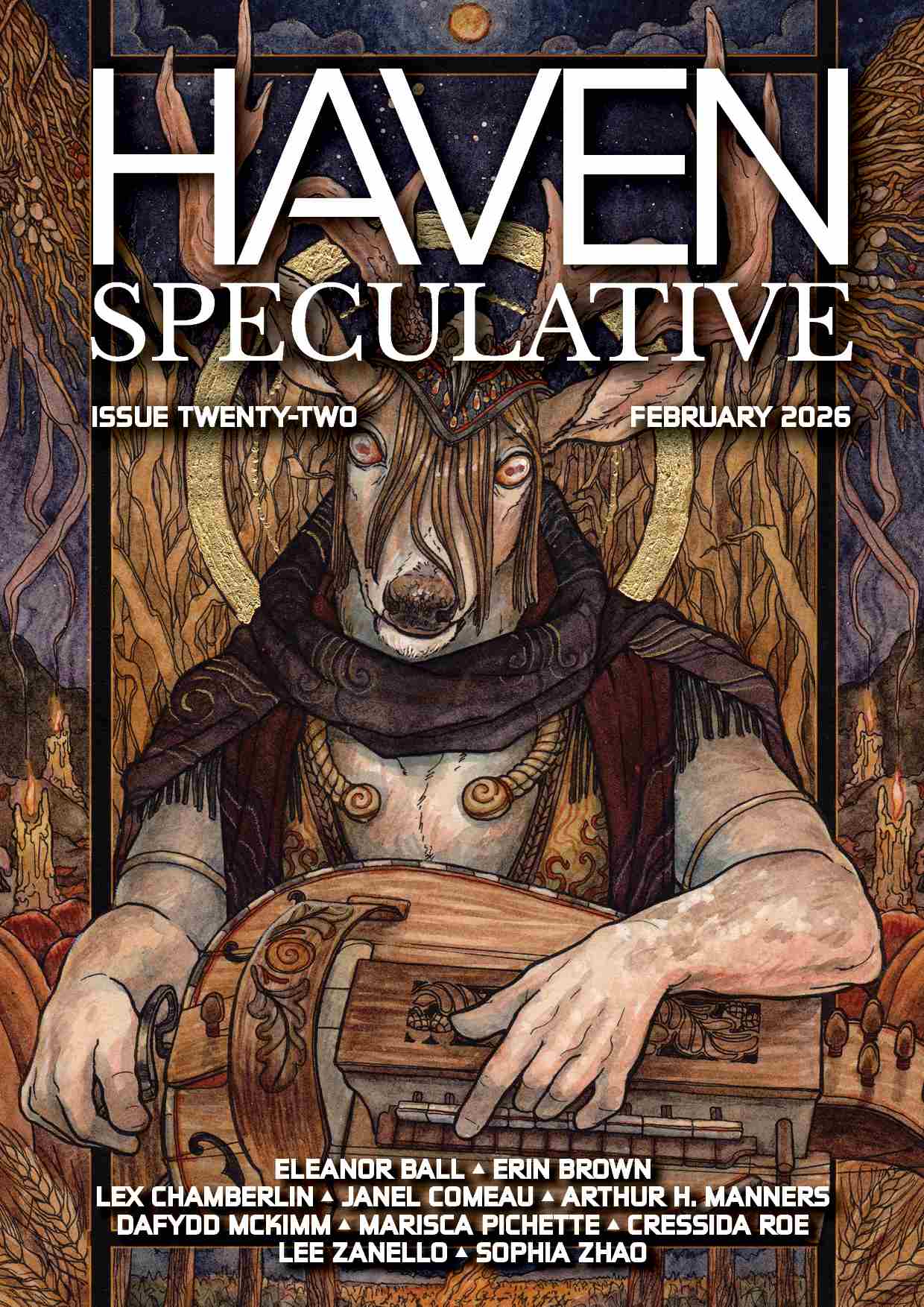
We are the Giants We Fear
by Lee Zanello in Issue Twenty-Two, February 2026
1875 words
This is a trick our uncle teaches us before he leaves. When the rumbling from the mountains makes our homes shake and we are scared or anxious, he calms us by forcing us to focus on our immediate environment. “Look for colours,” he says. “Something red, something brown, something yellow. Listen, really listen, to the space around you. This is your home and you are safe here.”
Our uncle teaches us many things as kids, my sister and me. We learn how to make a fire, which plants are edible and which can heal a wound. He takes us just past the edge of the woods outside of town, farther from home than our mother prefers, and shows us how to work with the wood we can gather, building smaller models of the sort of work he does when he is not with us.
He is good with his hands and whenever the town needs rebuilding, he is highly sought after, away for weeks, sleeping on job sites, getting homes and businesses rebuilt before the cold comes into the valley. When the work is done and we are whole again, he arrives back at ours and sleeps for three days, waking only to be fed by my mother, who dotes on him.
She misses our father.
We miss him too, but in a different way. We’d only known him for a few years each, and so the memories are fuzzy, though some creep back if we listen hard enough.
I am six when the ground shakes and the shadows in the twilight move toward us, slowly growing larger than the mountains behind them.
I watch a man get crushed to death. I am close enough to hear his bones pop. I cannot look away from the soup left behind until another man screams to my left, after taking an errant bullet to his belly. People are shooting everywhere, in every direction, hoping to hit something somewhere where it will hurt.
My sister and I are lifted into the air and, at first, we kick with fear until we realize it is our father and uncle rushing to bring us inside. We bury our faces into coats covered in blood that isn’t theirs.
My sister is screaming and the light dances on the wall from the flames outside the window and I am trying to calm her in the only way a six-year-old big brother knows how, by forgetting my own pain and holding her in my lap, rocking back and forth.
Our parents have rushed outside, our father trying to put out the fire, our mother hurrying the wounded to safety. Our uncle is at the table reloading the rifles. He shouts something at us but I do not remember what he says.
It is the loudest night of my life.
Our father comes through the front door and looks at us, and he is still looking at us when the whole roof and side of the house get torn up, lifted into the air, him and the door snatched up with it. Half our house hangs there for a moment before the giant attacking our town hurls it towards the sky. It gets smaller and smaller and we see our father lose his grip and fall. He is never found.
It takes us months to rebuild after that night and we are forced to live in the community shelter. Our uncle works without sleep, our mother watching over the children whose homes have been destroyed. She is always cooking or managing rations to ensure everyone is fed and warm. The community looks to her to lead us and, in the moments when her gaze falls on nothing in particular and she’s slow to respond in conversation, I get a sense of why she does this and the hole she is trying to fill.
It hurts to remember that my sister and I move on and rarely think of our father. I remember missing my room and our house, but not him. There are other children in the shelter to play with and there is no school, so after our chores are done, we adventure. Some parts of the town have been spared and these are the safe places we are allowed to be. Beyond that there are the construction sites, and beyond that, the wilderness.
With our mother so busy, we can easily escape for hours. No one fears another attack so soon after the last, and so we run to the hay fields and marshes and play giants and let the younger kids feel powerful while us older kids run amongst the reeds in playful fear.
Weeks later, we are camping with our uncle, and I know our mother is upset about this, but the rain has finally let up and our uncle is showing us how to clean a squirrel he has shot with his bow and arrow. We are fascinated. He talks as he cleans, tells us that I will also hear the call one day and lose myself to the mountains. I’ll grow and I won’t stop growing and I’ll lose some of the knowledge I have now, my mind not expanding to keep up with my bodies. He is quiet for a moment and we sit there in silence with him.
As he finishes up, he instructs my sister to build the fire and me to go and find his other arrow, the first one he’d shot, which spiralled off sideways and vanished into the trees.
I am farther in the woods than I have ever been alone, but I am unafraid, my eyes searching for the bright red feathers amongst the fallen logs and low branches near the riverbed. The sun hangs just over the mountains, the last rays of its light filtering through the branches and bouncing off the water.
My breath leaps into my throat because there it is, the arrow stuck into a log. I dash forward to grab it, but before I can, I’m plunged into sudden darkness. Instinct takes hold and I duck into the nearby brush for cover, not daring to breathe, wishing myself invisible. The rumble of a massive footstep shakes the leaves off the trees and I look up and see huge hands parting the treetops above me, branches cracking and falling, landing inches from where I hide. I stifle my screams and squeeze my eyes shut. I hear the treetops falling back together and the next footstep is farther away, the one after farther away still, and after a few moments I am alone.
When the giant is gone, I race back to my uncle and tell him the arrow is lost.
The next time the giants attack, I am older and I am in love. With only minor damage to the house, my sister and I will only be at the shelter for a few weeks, though we have more responsibility now, as does our mother.
My sister is old enough to be left alone, which works perfectly for me to sneak away. I have a dirt bike and my love and I ride together out of town, out to the edge of the woods, and lie in the grass to look up at the mountains. We share our thoughts and our dreams and our fears. We’ve both known loss. We both know what lies ahead.
For the first time since it happened, I tell someone about my brush with the giant when I went looking for my uncle’s arrow. My love gently mocks me for not turning to face the giant, for hiding, and so I do not bring it up again. When my family leaves the shelter and moves back into our house the next week, our love settles into the flirtation it always only was.
On the night our uncle leaves us, he is quiet at the dinner table.
Our mother asks him what is wrong and he says nothing. He only stands and takes off his sweater, sitting back down in his undershirt to eat his soup.
Later, when my sister and I turn in early, too afraid of what’s to come, my mother and him have a row like none we have ever heard. Plates shatter, doors slam, open, then slam again. He has heard the call but he believes he can go to the mountains and not lose himself. Maybe even help them, all the fathers and uncles who have gone before. My mother shouts he needs to stay, that he is leaving us to fend for ourselves.
It is the second loudest night of my life.
When they have calmed, we are called out to the living room and our fears are confirmed. Our uncle has his jacket on and his duffel packed. Our mother hides her eyes from us.
We know he is going to the mountains and this will be the last we see of him. He holds his arms out and we both rush to his embrace.
His head between ours, he whispers, “Remember what I’ve taught you.”
He leaves and we watch him from the doorstep until he is out of sight.
Lying in my bed, I hear our mother sobbing herself to sleep.
It’s been two years, and the giants haven’t attacked since my uncle answered the call. My sister and I don’t believe this is a coincidence.
We have rebuilt our town larger than ever, focusing our energies on the farms and ensuring we have enough food for the winters. Our mother doesn’t worry about rations anymore.
Last week, we heard it. Rumbling from the mountains. The same rumbling that always came before an attack. The giants are active and we fear they may be on the move.
I am in our kitchen and my duffel is packed. I am an echo of our uncle.
My sister understands. She knows I can handle myself out there, and besides, both of us know in our hearts I won’t be alone. Our uncle is waiting for me. I know he’s kept a part of himself intact, that he’s the reason the giants haven’t attacked again, but he may be losing himself. I need to help him any way I can. That’s what family does.
Our mother does not understand why I’m going now, when I am still so young. Her anger, this time, is quiet, for my sister’s sake, but I know it is there.
I head out on foot and I do not look back. Past the edge of town, past the hay fields and marshes, into the wilderness of the woods and the mountains.
My footsteps and breathing grow heavier and my clothes tighter as I trudge through the woods, following the river. A flash catches my eye, glinting in the last rays of daylight reflecting off the water. An arrow, stuck in a log.
As I pick the arrow up, smaller in my hands than it should be, the light on the log dims until the sun behind me is blotted out completely.
This time, I am not rooted to the ground, afraid to look, afraid to breathe.
This time I turn around, ready to face whatever, or whoever, is there.
© 2026 Lee Zanello
Lee Zanello
Lee Zanello is a writer and travel professional in Bancroft, Ontario, with a knack for making the small feel expansive. His daily flash fiction lives on Bluesky at lima-zulu.bsky.social, and his broader work at leezanello.com. “We Are the Giants We Fear” is his first published short story.