
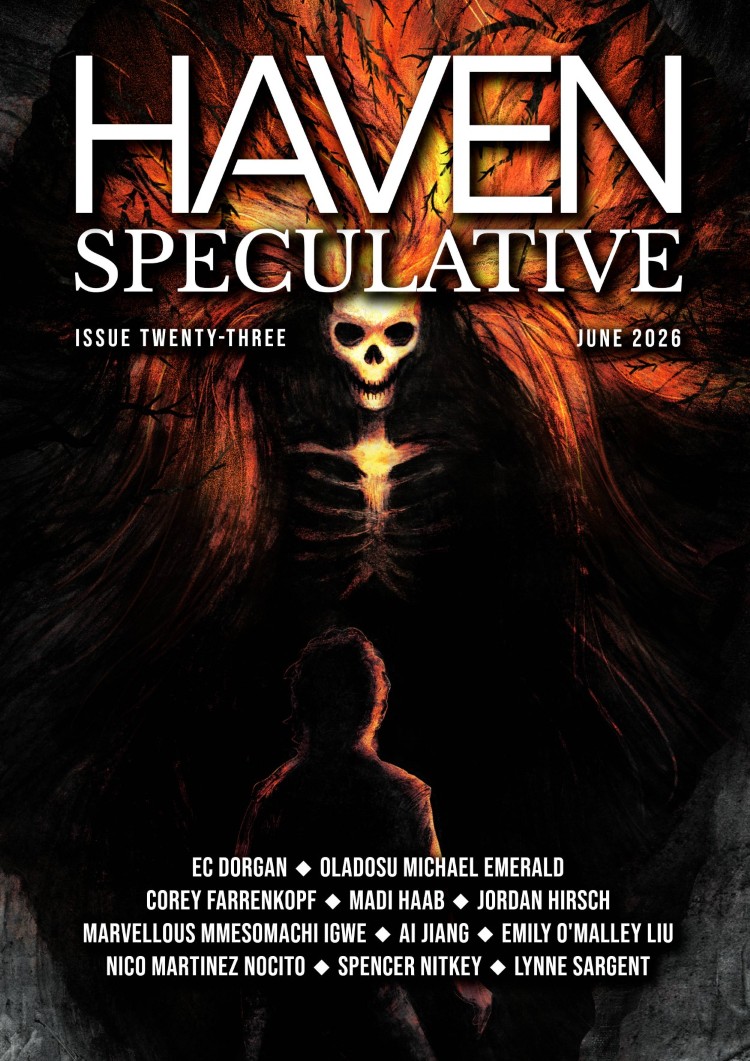
fiction
We Whose Fathers Have Transformed into Wild Animals of the Land, Sea, and Sky
by Spencer Nitkey in Issue Twenty-Three, June 2026
1644 words
Ten-Point Buck
Kaye dreams of killing his father. When I am not terrified of this dream, I am so jealous that I wish I could steal it through his lips. I don’t know what I’d do if I ever saw my father again. Kaye’s certainty calms me, violent as it is. Now, as Kaye stares down the sight of his rifle and the tremendous buck we’ve been tracking for three days comes up from the brush, he is closer than ever to achieving it. In the Sierra Nevada, mosquito-bitten and muddy, I am not jealous. My tongue tastes of pennies, and more than anything, I am sorry. I want to take Kaye in my hands, run his calloused fingers across my beard, and ground him in something, anything, other than the circle of his scope and his father’s beating heart.
Chameleon
Candice spends her nights watching her father’s scaled hands in a large aquarium tank she keeps in her living room. She stares at his weaving eyes and remembers his final human moments: A basketball game on TV was ending, and at the end of their cul-de-sac, her father finished his whiskey in two defeated gulps. She was seven years old and should have been asleep. Instead, she was waiting for the kitchen to clear so she could sneak another cupcake. She watched her father rise from his chair, leaving his sweating glass behind. He splashed his face with water in the kitchen sink and, poof, without warning, transformed into a fragile chameleon that could blend into everything. She tells our support group, in a dusty Methodist basement, that her skin-shifting father is finally settling in his new enclosure.
I realize, staring at Kaye, that I want him. Like Candice’s father, he too is a kind of chameleon: handsome, but in a “license and registration” kind of way, usually wearing camo, sharp-edged and with eyes that always seem to be looking for prey. There’s a comfort to his certainty, a safety in his body’s not-so-quiet suggestion that it’s capable of violence. Softness leaks through the all too visible cracks in his masculinity. I could fit neatly, a kind of emotional kintsugi, with myself the gold to mend the shattered pottery of his heart. I haven’t told the group my story yet—not because it hurts too much, but because I still didn’t know how I feel.
Turkey Vulture
Ira, who was 50 when her father turned, got a panicked call from her mother’s ranch home. By the time Ira arrived, animal control had caged her 80-year-old father-turned-turkey-vulture, and there was already a man named Bruce helping her mother fence a pasture. Two months later, they buried an empty coffin, her father carried away by coyotes in the crepuscular morning.
Kaye’s eyes flash like a flint spark over tinder, and that night, he falls asleep in my arms for the first time. I study every twitch, wondering which one means he’s pulled the trigger and killed his father. In the morning, he tells me that when he finally has his shot, he hopes he is brave enough to aim true.
Gyrfalcon
Sampson’s father turned at 45. His father’s father turned at 45. His father’s father’s father at 43. Each became a winged bird of prey that cut the morning sun like a steak knife. He tells the group he is trying to be different. He sees a therapist. He loves his wife gently, instead of in fits and spurts. He doesn’t work a job he hates. He doesn’t hit his children. He hasn’t even had any. Still, everyday, he observes dawn with a tightness that straddles fear and excitement. He wants to be better. He says he feels the sky call to him like an old friend, and that he hates the part of himself that comes from this long line of sharp-taloned men.
Kaye whispers to me that shooting a bird is one of the true tests of a marksman. Anyone can plunge a bullet into a standing creature, but piercing the sky, watching something beautiful and feathered fall back to earth, is perfection. At night, I breathe him in, his shoulder pressing against my mouth, hoping to catch some of his anger. If I could, maybe I’d know what to do with the overflowing tackle box that sits in my chest, impossible to untangle.
Millipede
Audrey’s father was a good man, she says, her eyes heavy with tears. She’s only 16 and has come with her mother. He was a fireman and looked like a balding Smokey Bear. He’d hoisted her up on her shoulders at baseball games. If she’d asked, he’d have flayed himself to make her a coat.
She’d lost (then found) him in their backyard. She was swinging from the playset he’d built her three summers ago. His hands were on her back, pushing her higher and higher. One moment, she was screaming with glee in the weightless second that her father’s hands left her back. The next, he was gone. She returned, falling through the empty air, and it took twenty minutes of digging through the cedar mulch to find her many-legged father transformed into a writhing millipede. He clung to her hands as she rescued him from the dirt, “like a thousand legs trying to remember how to hug her.”
Before I met Kaye I would catch the mice that invaded my apartment each spring and release them in a wide field just outside the city limits. I wake some nights in his apartment to the sound of traps snapping shut on necks. It’s easier, I’ll admit, to kill rather than care. Kaye bought me my first hunting rifle and taught me how to shoot at a range. I was, according to him, a natural. I wondered what it meant to be a natural at something violent. I wondered if my father had ever shot a gun. I wondered if Kaye was rotting me, like a moldy berry that spoils everything it sits near. I shot on the exhale, with both eyes open, and my shoulder buzzed numbly against the recoil. Did I love Kaye not because he was strong but because he numbed me too?
Ten Point Buck (ii)
Kaye never told the group what happened, but he told me. His father transformed in the mudroom, cleaning his hands and rinsing his hunting boots. His mother was hanging his coat behind him. As quick as a bullet he shifted from man to deer: 10 point antlers, a streak of red down his chest, one eye larger than the other.
Kaye heard the braying and stomping from the living room. He heard his mother’s sharp cries turn gargling and smothered as he ran toward the trashing. He entered and saw his father snorting over his mother’s bloody body, his antlers dripping red. Kaye went for the rifle, just as the buck broke through the window behind the sink and disappeared into the forest.
He says he’s tried to forget his mother’s last moments. He’s never forgotten his father.
That’s how he knows he has him now: across the field, light-headed in the high altitude of the Sierra Nevada, where he’s searched hundreds of times alone. This time, I’m with him. This time, he’s found his father.
“Don’t,” I whisper in his ear. “It won’t feel any better.”
He grunts. He’s focused. The steeled expression on his face that once drove me to him seems completely cold; the faint cracks I’d once imagined myself within are filled with cement and hate now. I turn from him to the buck and stare at its red-streaked chest through my binoculars. When it turns its head towards us, it blinks with one eye larger than the other. Kaye’s right, of course. It is him.
“I won’t watch you do this,” I say, leaving him and his father. I sling my own gun over my shoulder, unsure why I’ve even brought it, and beat my way back to the trail. I look back once, desperate and straining to see through the trampled thickets if Kaye can resist turning into his own kind of animal. Not all transformations are external.
Five minutes later, a rifle shot burns through the silence, piercing the humid air. I will never know what happened, but I beg the empty space beside me that I once hoped he’d fill forever that he was brave enough to miss.
Rainbow Trout
My father spins at the end of a thin nylon fishing line. He is not heavy, but the rod bows gently as I pull him from the lake where my mother and I rehomed him after he transformed. The sun shimmers and refracts through the dozen droplets of water his scaled body sends sailing as he breaks the lake’s surface and twirls. Up against the rocks, I fish the hook from his mouth. I hold his squirming body in my hand. I don’t have long with him. I’ll have to throw him back soon. What does a child say to a father who has transformed into a trout? To a father who has left them, not–you hope–because he wanted to, but because it was his nature? There is too much to say. None of it fits in language; it’s a want, as thin as a nylon string that ties us together.
“I hope you are proud of me,” I say finally. I tell him about Kaye, about mom, about the horrible tangled fishing line in my chest that gets more knotted everyday he’s gone. “I miss you,” I add, kissing his head.
I throw him back. My heart ripples, like the shimmers his body leaves on the surface of the lake as he disappears below the water. His waves spread out, lapping the muddy banks.
My heart’s spread out, too, but there’s no bank for them. They spread and spread forever.
© 2026 Spencer Nitkey
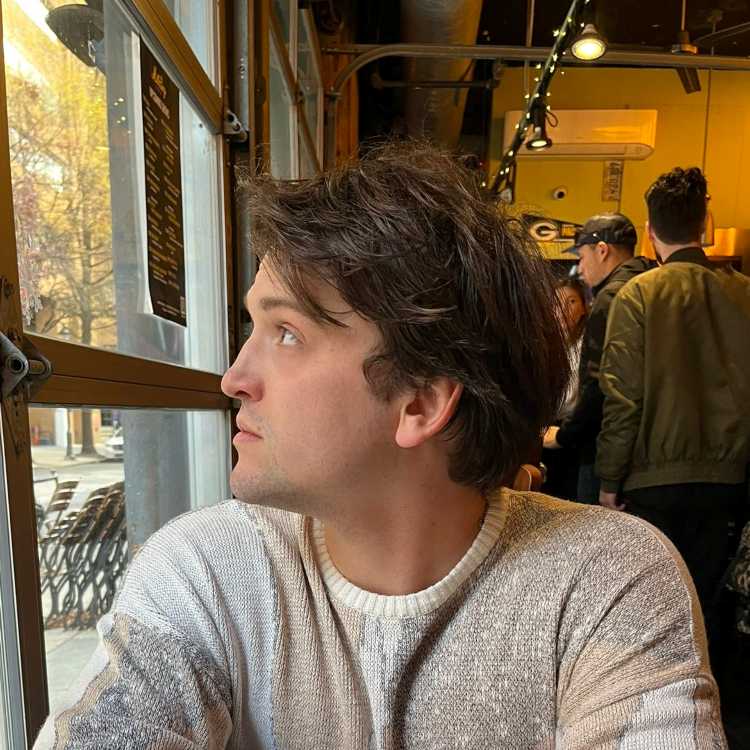
Spencer Nitkey
Spencer Nitkey is a writer, researcher, and educator. He lives in Philadelphia with his witch wife and a dog named after a French postmodernist. His writing has appeared in Apex Magazine, The Adroit Journal, Lightspeed Magazine, Nature Futures, Weird Horror, and many others. You can find more about him on his website, spencernitkey.com.